
From fire-extinguishing baubles to a Santa detector. Quirky Christmas inventions from the 19th and 20th centuries
A Christmas tree that puts out fires on its own. A stocking that “proves” Santa really was there. Although both ideas sound like modern gadgets, they are anything but. Over a century ago, inventors tried to tame Christmas with the help of engineering - sometimes surprisingly ingenious, and sometimes… disturbingly literal. Discover 6 Christmas patents that reveal the real problems of the era and how much our approach to safety, comfort, and the very magic of the holidays has changed.
- Traditional Christmas trees were a real source of danger, particularly fire hazards. Inventors focused not on controlling risks but on “taming” them through clever designs.
- As early as the beginning of the 20th century, the idea of an artificial Christmas tree emerged as a practical and safer solution. This shows that modern choices have a long, rational history.
- Christmas patents concerned not only technology, but also emotions and rituals. Inventions such as the Santa detector prove that engineering also sought to enhance family experiences.
In the U.S. Patent Office records from the 19th and 20th centuries, we find ideas that today elicit a smile or surprise. But each of them solved a specific problem: stability, fire, lack of light, the need for magic.
Discover the history of Christmas as seen through the eyes of engineers from over 100 years ago. In this article, we present the creative and innovative ideas of inventors - solutions ranging from practical gadgets to holiday gifts.
Table of Contents:
- Artificial Christmas tree from 1917
- Fire extinguisher ornaments from 1954 and 1957
- Disappearing Santa in the chimney from 1964
Christmas tree stand from 1876
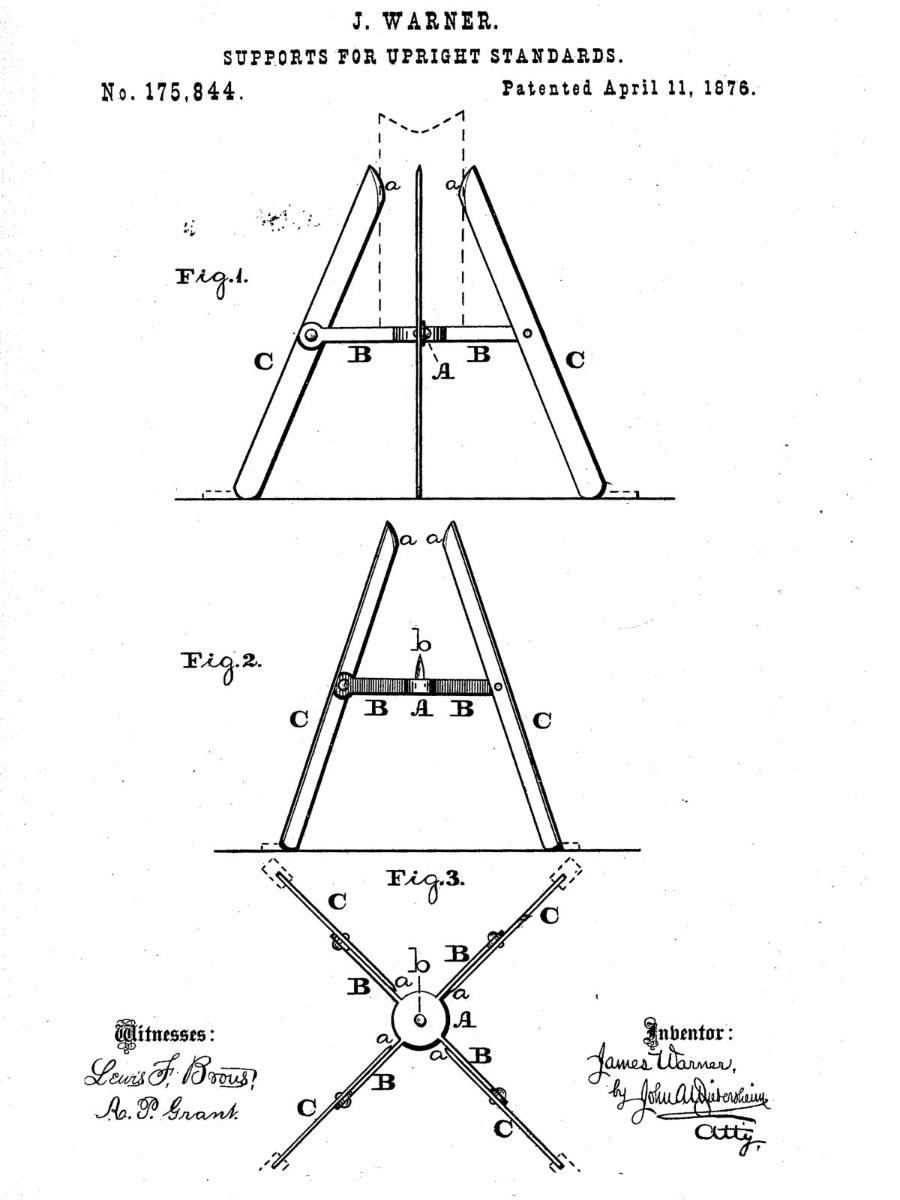
James Warner, “Improvement in Supports for Upright Standards”, US Patent No. 175844A, April 11, 1876
Anyone who has ever set up a live tree in the living room knows that moment. The trunk turns out to be more crooked than it seemed when you bought it, the tree leans slightly to one side, and after a few adjustments, everyone starts looking at it from different corners of the room, trying to determine if it’s really standing straight...
It was precisely this very domestic dilemma that sparked James Warner’s patent. The patent application had a rather broad title (“Improvement in Supports for Upright Standards”) and formally concerned supports for vertical objects, but in the description, the inventor explicitly identified Christmas trees as one of the applications.
The design was very clever. At the center was a central support with a spike that drove into the lower part of the trunk. Radiating arms extended from it, to which hinged legs were attached. Each leg was mounted roughly in the middle of its length, so that its upper part pressed against the trunk, while the lower part widened the base. The harder the tree pressed against the center of the structure, the wider the lower parts of the legs spread apart, and the more securely the upper sections gripped the trunk.
What might such a stand have looked like? Here is our vision:

It is worth comparing this historical solution with today’s Christmas tree stands, which are often equipped with a water reservoir. Another interesting innovation is the patent for Ronald Sowers’ automatic Christmas tree watering system. This system automatically supplied water to the soil via a reservoir, a hose, and a special strap, eliminating the need for manual watering.
Christmas Candle Holder from 1886
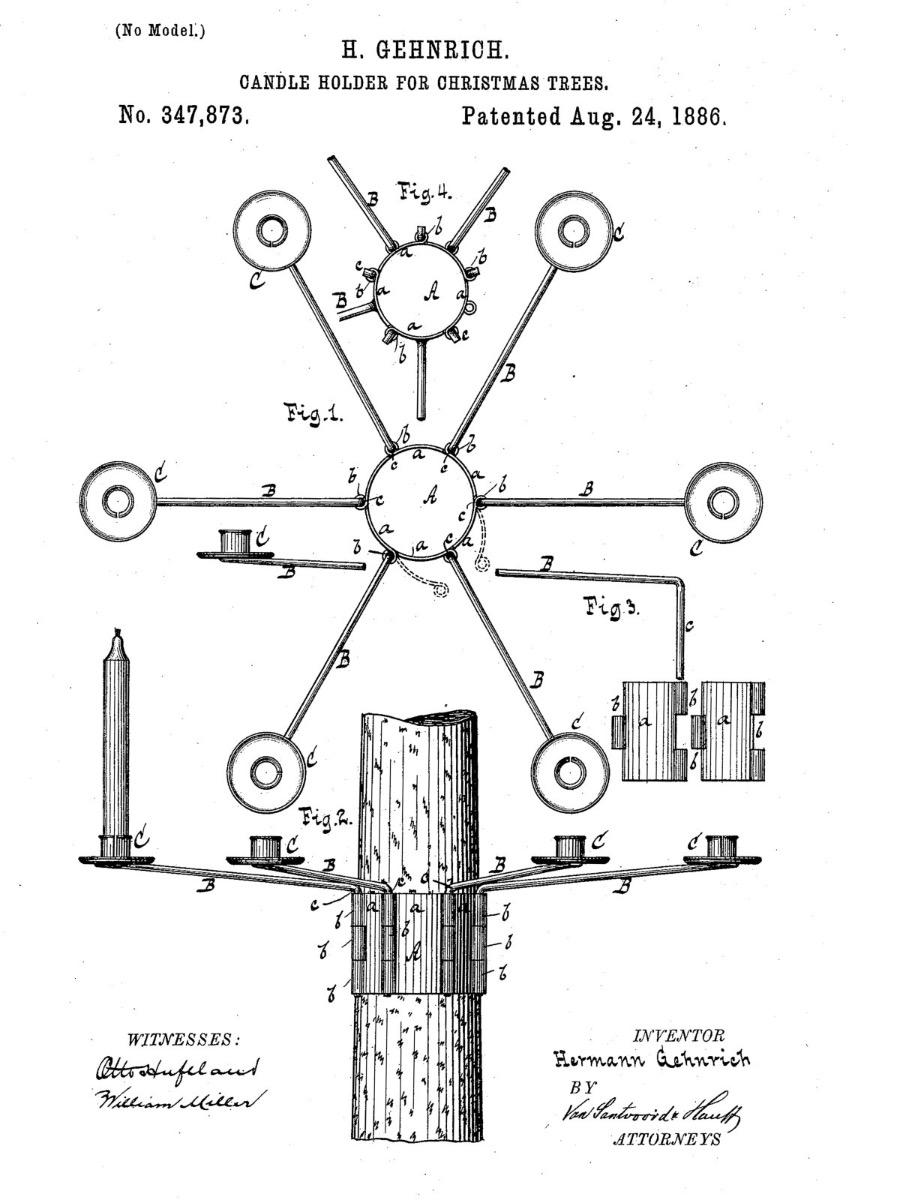
Hermann Gehnrich, “Candle Holder for Christmas Trees”, patent US347873A, August 24, 1886
Today’s festive atmosphere relies mainly on electric light: we have delicate lights with a warm glow, along with safety and convenience. In 1886, things were different. Christmas trees were lit by real candles, and inventors had not yet considered moving away from open flames entirely.
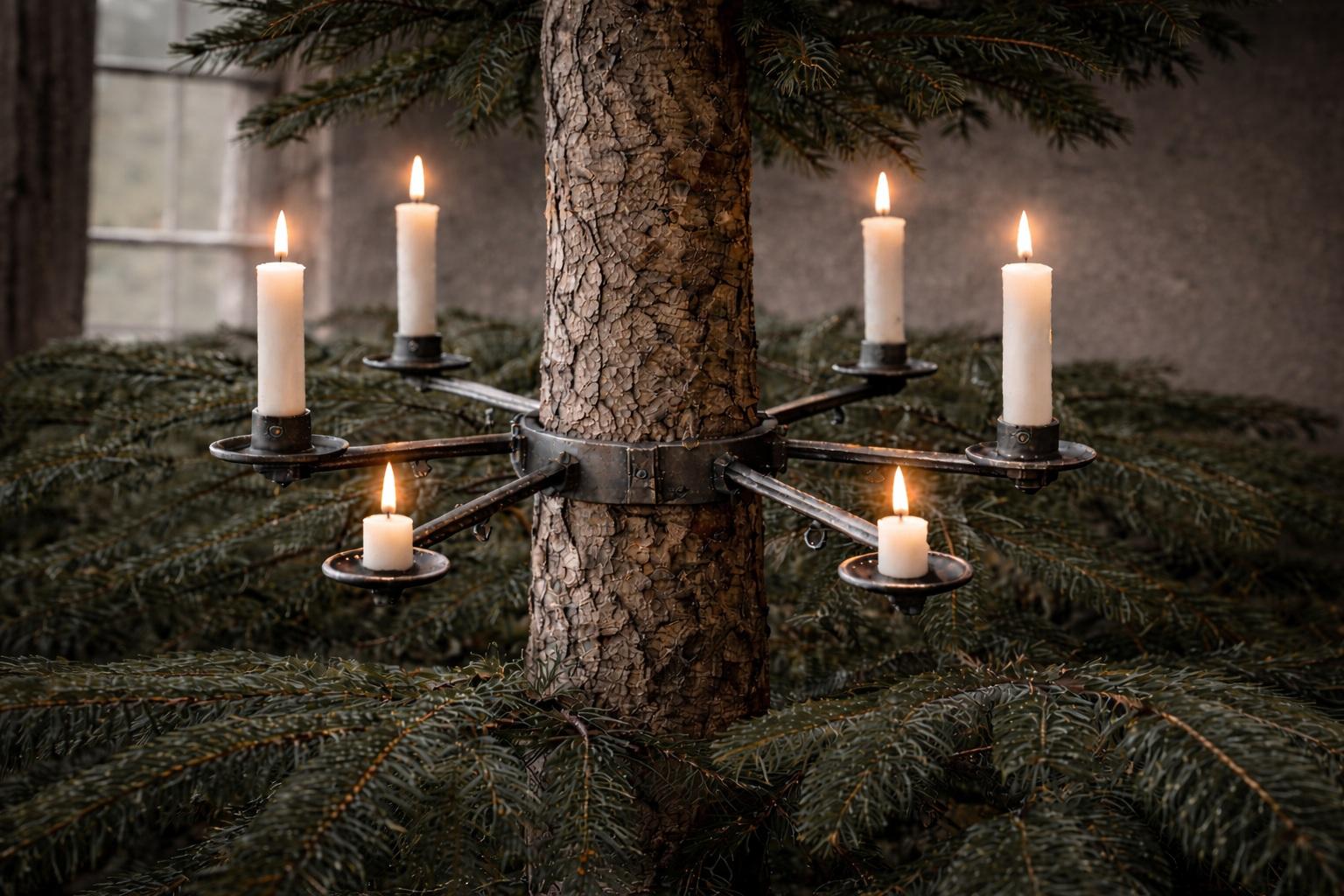
Hermann Gehnrich’s 1886 patent concerned a candle holder attached directly to the trunk of the Christmas tree. The basis of the design was a ring encircling the trunk, to which arms ending in candle holders were attached.
The practical strength of this solution lay in its adjustability. The ring could be opened, wrapped around the trunk, adjusted to its diameter, closed, and then placed at any height. The inventor clearly noted that the Christmas tree trunk tapers toward the top, so the holder had to be able to accommodate different diameters. Segments could be added or removed, making the design suitable for various trees and different locations on the trunk.
Here’s what Gehnrich’s patented candle holder might have looked like:
Interestingly, Edward Johnson invented electric Christmas tree lights a few years earlier - in 1882. He installed them on a Christmas tree in his New York City apartment. Initially, electric lights were a luxury. According to historical accounts, in 1900 a set of Christmas tree lights cost $300, which was half the price of an average car. Over time, however, prices dropped, and people began prioritizing safety. Dangerous candles became a thing of the past, and lights became one of the most sought-after elements of Christmas decor.
Artificial Christmas Tree from 1917
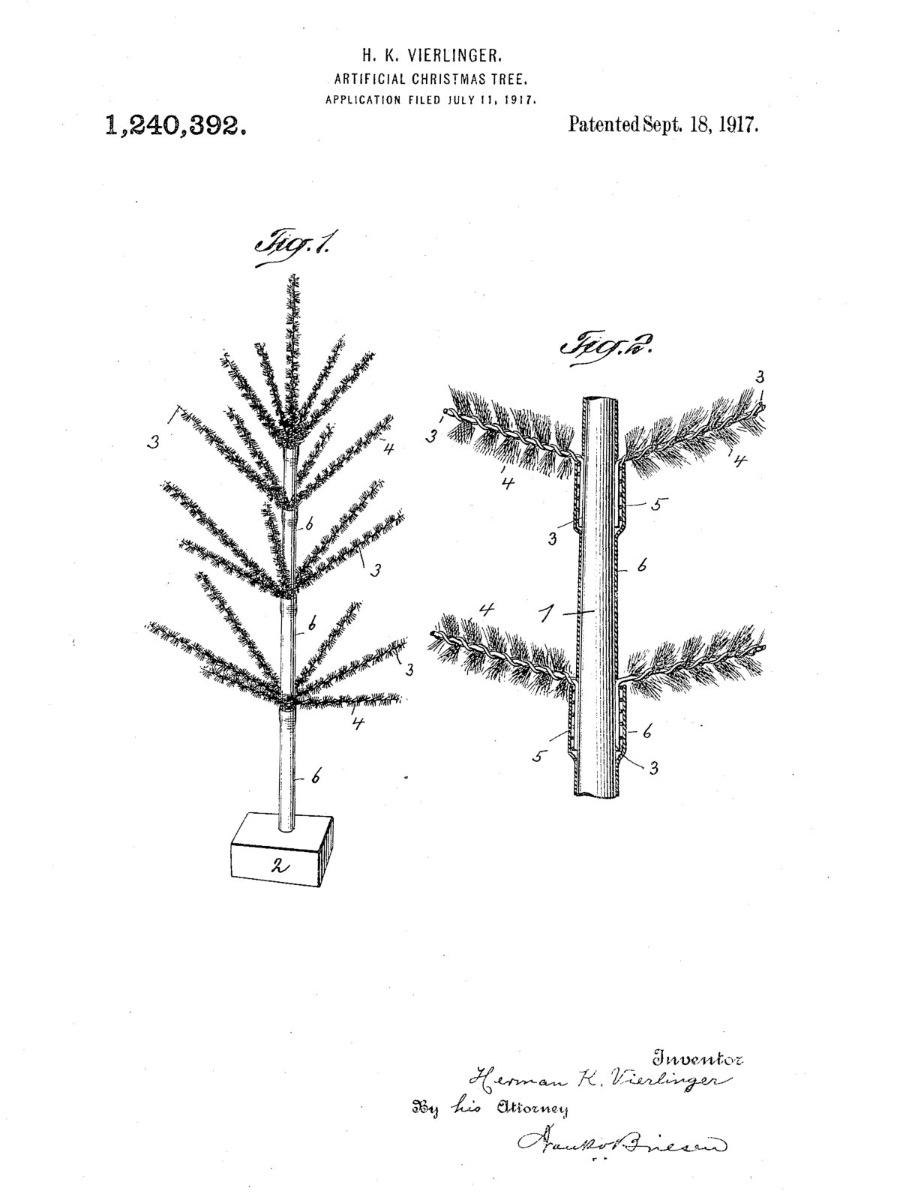
Herman K. Vierlinger, “Artificial Christmas Tree”, patent US1240392A, September 18, 1917
In many homes, preparing for the holidays involves a quiet organizational aspect. You have to fetch something from the basement or attic, set it up, organize it, and then put it away again after the holidays. The more responsibilities and December fatigue there are in the family, the more clearly you see the value of solutions that simply make life easier. Herman K. Vierlinger’s patent is remarkable precisely because as early as 1917, he was thinking about a tree in exactly this way.
The 1917 patent does not yet resemble modern models of artificial Christmas trees, but it clearly shows that the need for a practical, durable, and safer tree has a much longer history than one might think. The invention concerned an artificial Christmas tree consisting of a trunk mounted on a base and branches made of twisted wires.
Short metal threads - a sort of tinsel - were woven between these wires to create the visual effect of pine needles. The individual strands stuck out in different directions, making the branches appear denser and more brush-like. The attachment points were concealed with paper or similar covers so that the whole thing resembled a more natural tree.
The patent also strongly emphasized functionality. The branches were to be flexible enough to fold along the trunk during storage, and once unfolded, retain their shape and hold decorations. In practice, this meant a seasonal product that could be stored more easily and then reused. Sound familiar? These are exactly the advantages many families look for in artificial Christmas trees today!

The issue of fire safety was also very important. The patent emphasized that such a design is practically fireproof, or at least significantly less prone to catching fire than a natural tree. In the context of earlier candles and later fire extinguisher patents, this argument takes on particular significance.
Fire-extinguishing baubles from 1954 and 1957
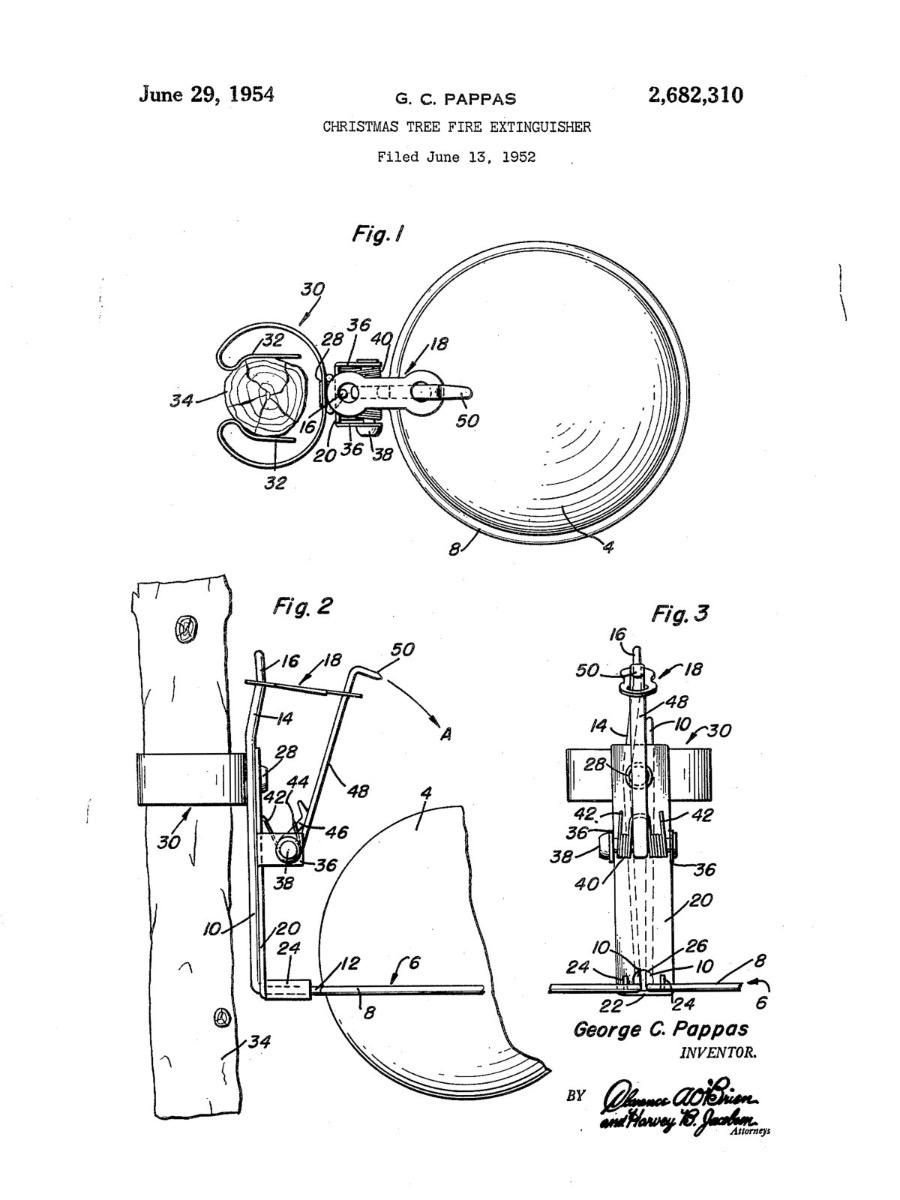
George G. Pappas, “Christmas Tree Fire Extinguisher”, patent US2682310A, June 29, 1954
In the family home, the Christmas tree captures everyone’s attention - it catches the eye and sets the mood. And that is precisely why, for many years, it was also the source of the greatest concern. When a flame appeared nearby (e.g., from a Gehrich candle holder), the danger grew rapidly. George G. Pappas’s patent shows how seriously this problem was taken in the mid-20th century.
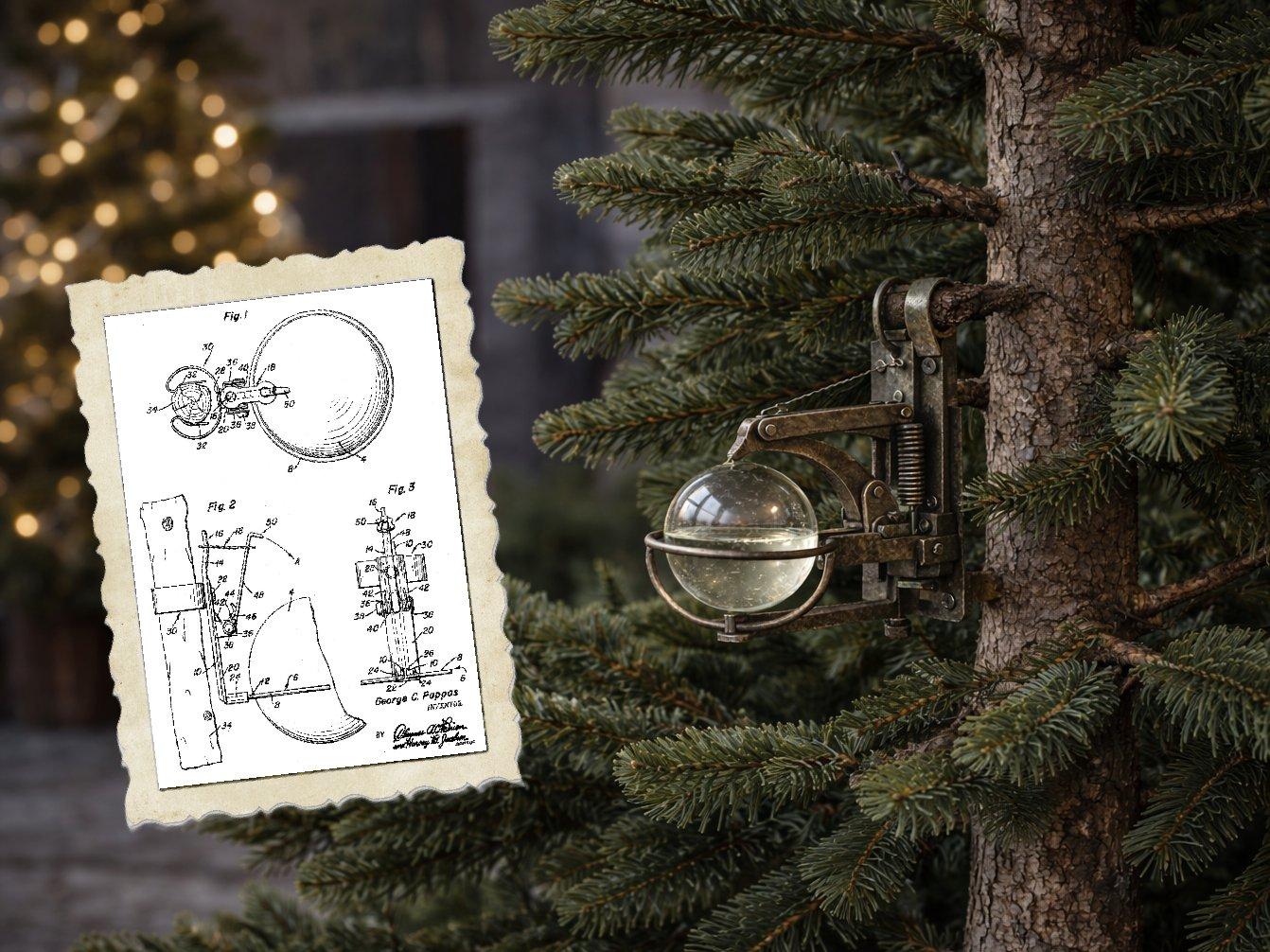
Pappas designed a fire-extinguishing device disguised as a Christmas ornament. The most important element was a fragile sphere resembling a bauble. Inside was a fire-extinguishing liquid.
The sphere rested in a wire basket or ring, and the entire assembly was attached to a tree trunk or branch with a clamp. The mechanism was always ready to activate - thanks to a spring-loaded hammer that blocked a fusible link reacting to rising temperatures. When a fire broke out nearby, the heat melted the locking element. The hammer would release, strike the fragile sphere, shatter it, and release the fire extinguishing liquid.
The method of operation is very characteristic of its era. The entire mechanism relied on the deliberate destruction of the container at the moment of danger.

In reality, the patent was very crude. It lacked subtlety and discreet safety systems. It is a very direct response to the real fear present in many homes. That is precisely why this invention is so memorable - much like Robert Lehder’s 1957 invention.
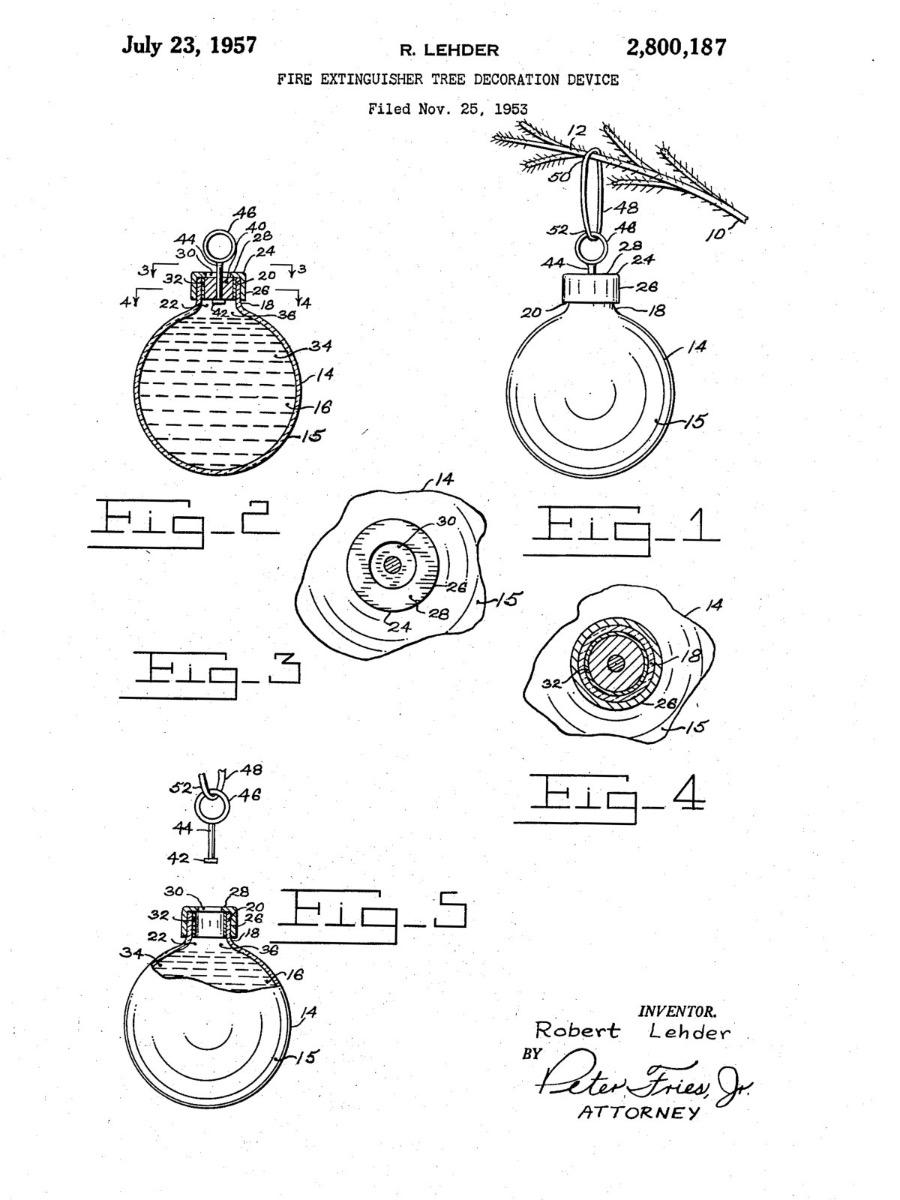
Robert Lehder, “Fire Extinguisher Tree Decoration Device”, patent US2800187A, July 23, 1957
Robert Lehder’s patent develops a similar idea but takes it in a different direction. It is still a Christmas decoration concealing fire extinguishing fluid, but the activation mechanism itself is different. Instead of a hammer, the solution relies on the ornament falling off the branch.
The decoration took the form of a fragile bauble filled with fire extinguishing fluid. The neck contained a fusible plug, embedded within which was the element used to hang the bauble on the Christmas tree. The heat acted precisely on this part. As the temperature rose to a dangerous level, the material began to melt, the hanger lost its grip, the ornament fell to the floor, and upon breaking, released the fire-extinguishing agent.
This solution seems even more interesting than Pappas’s patent, as it requires neither a hammer nor a tensioned spring. All that is needed is temperature and gravity. In theory, several such ornaments could be triggered almost simultaneously, producing a stronger effect.
The patent description firmly anchors the whole concept in the realities of the era. The inventor addressed a real fire hazard: flammable Christmas trees, decorations, and materials imitating snow. This part of the history of Christmas patents is surprisingly moving, because beneath the technical layer, a very simple intention is visible. Someone was trying to preserve domestic peace before the situation spiraled out of control.

A 1964 Christmas patent for a disappearing Santa in the chimney
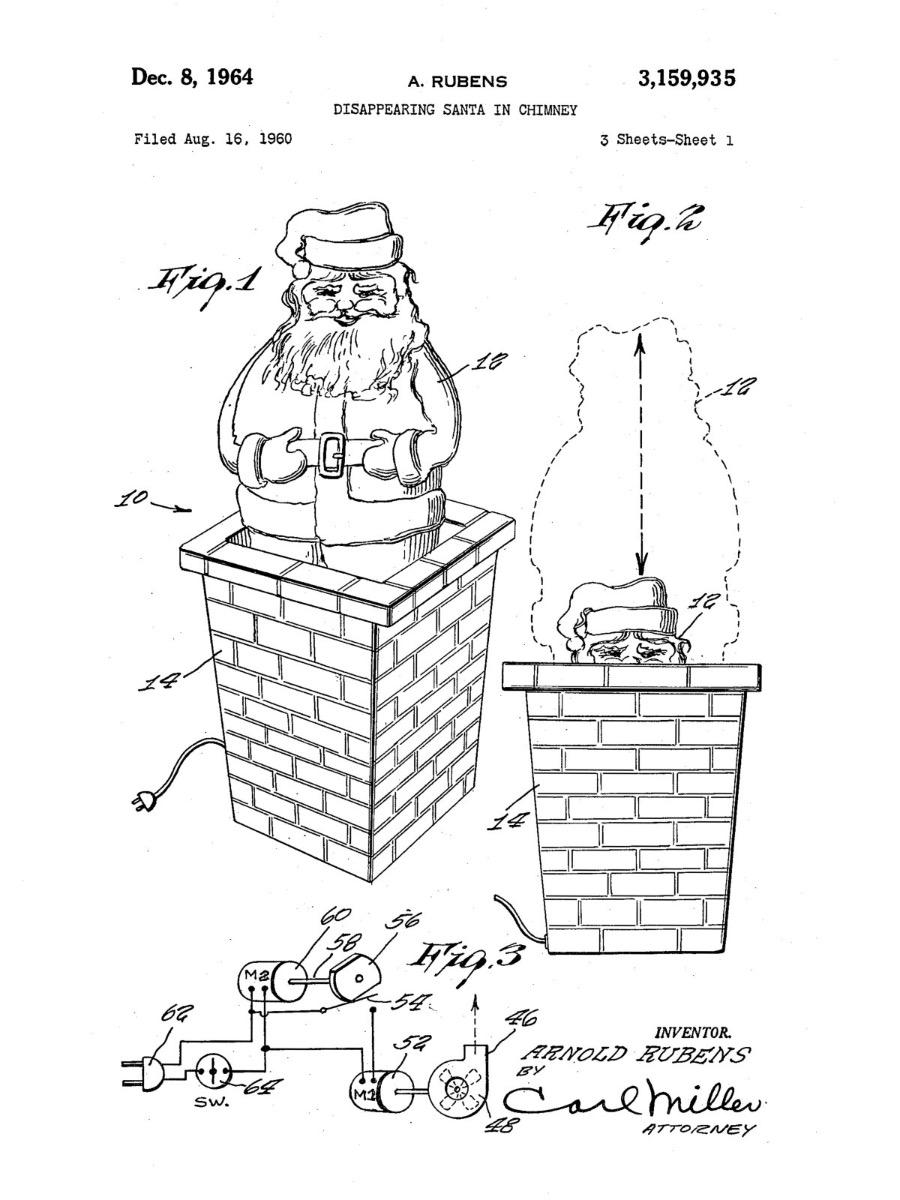
Arnold Rubens, “Disappearing Santa in Chimney”, patent US3159935A, December 8, 1964
At a certain point, the history of Christmas patents takes a turn toward spectacle. The home remains important, but alongside the family living room, displays and decorations designed for effect are appearing more and more prominently - as in Arnold Rubens’s patent.
The invention featured an animated scene in which a Santa Claus figure emerges from a chimney and then disappears back inside. The entire mechanism was based on a chimney-like housing, a flexible figure cover, an inflatable bag, a blower, a motor, and a simple control system. Another important element was a telescopic guide that stabilized the figure’s movement.
The mechanism worked quite impressively - the blower filled the bag with air, the bag expanded, the Santa figure rose upward and emerged from the chimney. When the control system shut off the air supply, the bag deflated, and the figure dropped back inside. The movement was cyclical. The telescopic guide ensured that Santa didn’t sway from side to side but moved vertically. Surprisingly elegant for such a simple operating principle!
The invention is designed to catch the eye, amuse, and create a festive scene. It’s easy to imagine a child standing in front of such a chimney several times in a row, hoping to see Santa again.
Rubens’s patent marked the beginning of modern Christmas decorations, which are meant not only to adorn but also to move, shine, surprise, and catch the eye.

It’s worth noting that the venues for Christmas displays and exhibitions vary by country - sometimes it’s a home, other times a public space or store windows. There are many unusual Christmas traditions around the world related to specific places and customs: in Japan, it’s popular to eat fried chicken from KFC during Christmas; in Spain, the grand National Lottery draw “El Gordo” takes place on December 22; in Norway, brooms are hidden during Christmas so they won’t be stolen by evil spirits, and in Mexico, Las Posadas - a three-week celebration symbolizing the journey to Bethlehem - begins on December 16. And in Ireland, a glass of Guinness and a cookie are left at the foot of the Christmas tree for Santa Claus.
The 1994 Santa Claus Detector, which builds festive cheer
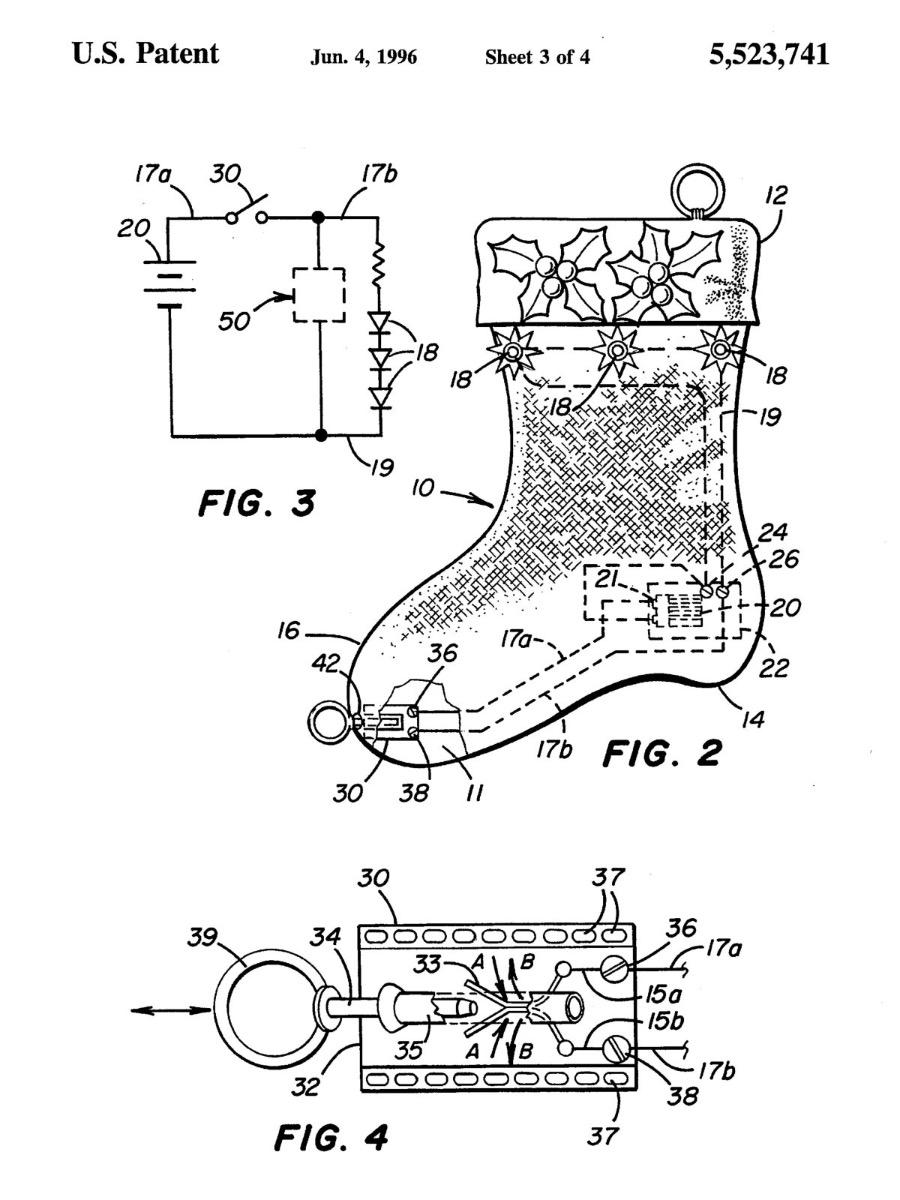
Thomas Cane, “Santa Claus Detector”, patent US5523741A, June 4, 1996
The most heartwarming patent in the entire collection appears only at the end of the 20th century. It goes to the very heart of the family Christmas story and attempts to give it a tangible trace.
The Santa Claus Detector, patented by Thomas Cane, signals to children that Santa has arrived. The basic version of the invention was a Christmas stocking with a built-in lighting system. The patent also provided for an extended variant, namely an illuminated figurine of a recognizable character, such as Santa Claus himself. The stocking version included an interior for small gifts, a light source visible from the outside, a battery, a switch, and a pull cord to activate the mechanism. Some variants also featured a musical module.
The principle of operation was simple - the stocking hung by the fireplace or in another festive spot. At night, an adult would pull the cord, close the circuit, and activate the light, and sometimes the sound as well. In the morning, the child would see the glowing decoration and interpret it as a sign of Santa’s nighttime visit.

Cane’s invention nicely illustrates how far the evolution of Christmas inventions has come. In all its simplicity, it reveals a very heartwarming truth about the holidays: adults have long tried to arrange them so that children can believe wholeheartedly, if only for a moment.