
Myths about artificial Christmas trees. We dispel them all!
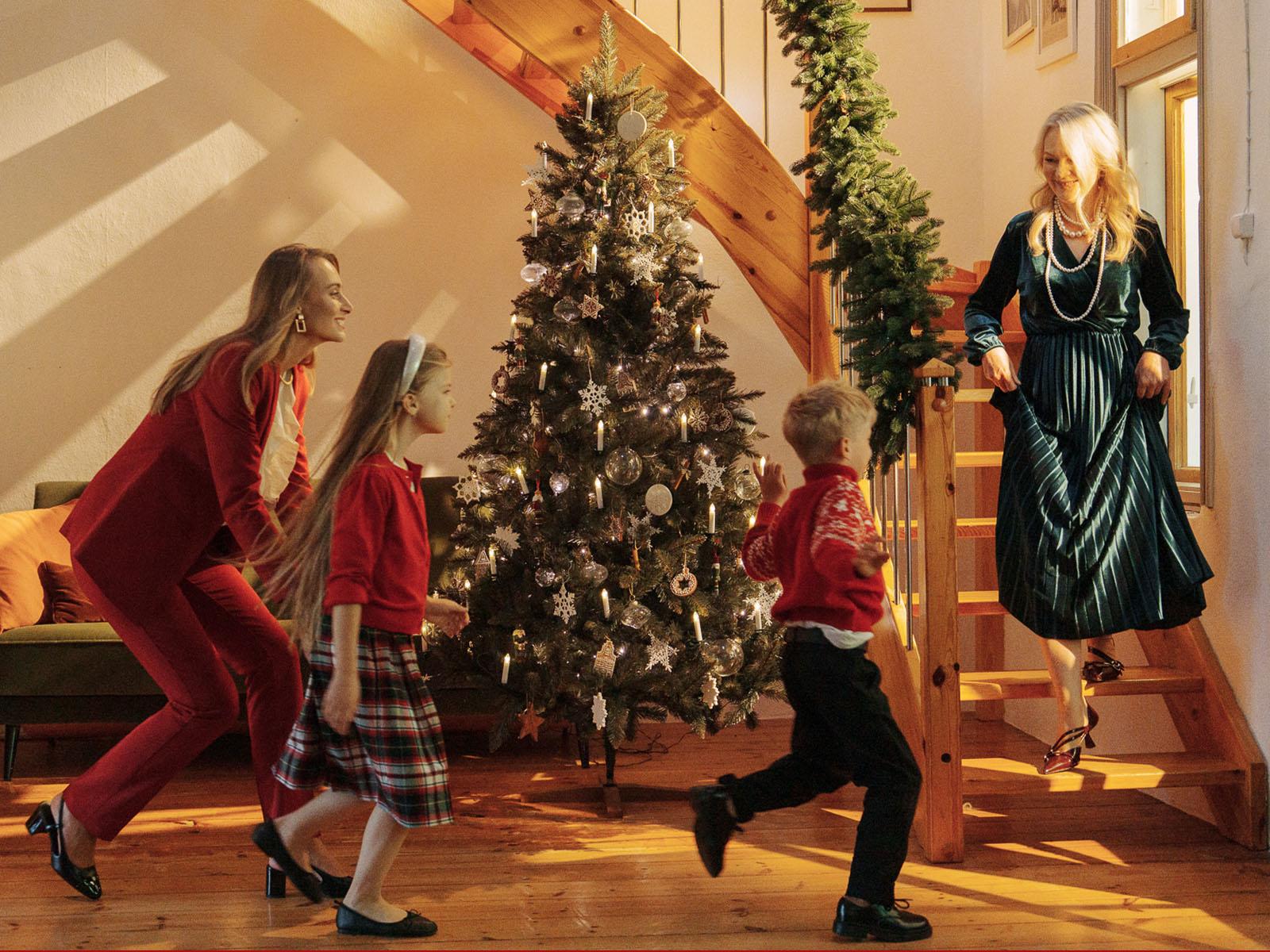
The Christmas season often starts with a familiar dilemma: “What kind of Christmas tree should we choose this year?” A whole list of thoughts comes to mind immediately: will it fit in the living room, will it be safe for children and pets, how will it cope with allergies, can it be decorated beautifully… On top of that, there are various opinions and myths about artificial trees, which can easily create confusion about Christmas traditions and choosing a Christmas tree, especially during the holiday season when these traditions are most celebrated. So we’ve collected the most popular myths about artificial Christmas trees and compared them with the facts. This way, you’ll be left with just one pleasant task: choosing a tree that will make the whole family feel the Christmas spirit!
- Today’s artificial Christmas trees are designed with families, safety, and a cozy look in mind. They are increasingly becoming a peaceful backdrop for Christmas gatherings, rather than another thing to worry about.
- Modern trees differ in scent, shape, material, and even the way they can be stored. This makes it easier to match the tree to a small apartment, allergies in the family, or the presence of a curious cat.
- The decision to buy an artificial Christmas tree combines convenience with sentiment. The longer a tree will serve in your home, the more it will gain in value and in the memories of the whole family, evoking the nostalgia of Christmases past.
Choosing a Christmas tree is rarely a purely technical decision. One question about the tree suddenly raises a whole host of others: where will we put it, will the children be able to reach the lowest branches, how will the cat react, will there still be room for Christmas games on the floor in our small living room? It is a choice that reflects you, your taste, individual style, and personal preferences – that is why every Christmas tree can be unique. Sharing the experience of decorating and enjoying the tree with friends as well as family makes the holiday season even more special.
There are also myths about artificial Christmas trees that easily creep into family conversations. Can a PVC Christmas tree smell nice, look good in photos, and last for years? Let’s dispel any doubts so that choosing a tree becomes simply a pleasant part of the preparations!
Table of contents:
- All artificial Christmas trees look the same
- Artificial Christmas trees take up too much space
- Choosing an artificial Christmas tree is just for convenience
- An artificial Christmas tree cannot be decorated beautifully
- An artificial Christmas tree is a big expense
- Artificial Christmas trees are not environmentally friendly

Myth 1. Artificial Christmas trees smell bad like plastic
Fact: Well-made artificial Christmas trees have a delicate scent that quickly disappears.
When you take it out of the box, you may smell a slight scent of a new item - similar to that of new furniture. This is a natural stage after transport and storage of most artificial trees. In FairyTrees models, we use materials selected to ensure that this stage lasts as short as possible.
If you have a sensitive nose or someone in your household is particularly sensitive to smells, plan to air out the room where the tree will stand for a few hours. Unfold the tree, gently shake the branches, and open the window. In a short time, even the previously noticeable smell of plastic will turn into a neutral background for the scent of gingerbread and tangerines. Let this be your own special, peaceful ritual!
A small, practical cheat sheet to get you started:
-
Unwrap the tree and let it rest for a few hours in a well-ventilated room.
-
If you like the smell of Christmas spices, place oranges with cloves or cinnamon next to it. Then your home will smell like Christmas.
Myth 2. Artificial Christmas trees look unnatural
Fact: An artificial Christmas tree can imitate a real tree very faithfully, especially when it combines the right material, color, and well-arranged branches.
An artificial Christmas tree, like a real one, has varied needles, several shades of green, and branches that are arranged just like in a real forest. At FairyTrees, we use modern materials, including molded PE polyethylene. This gives the needles on the edges of the branches a shape and thickness very similar to natural ones. High-quality artificial Christmas trees made of polyethylene look so realistic that it is difficult to distinguish them from real trees.
Many models combine PE with classic PVC. The PE elements ensure a realistic finish on the outside, while the PVC elements provide density on the inside. Our offer includes various versions of Christmas trees – from classic to modern, with a variety of looks and styles, allowing you to match your Christmas tree to any interior. Details also play an important role in a realistic artificial Christmas tree: slightly lighter tips, a slightly darker center, and a natural crown line.
Finally, there is one more step that is often overlooked - fluffing, i.e. gently spreading and shaping each branch. With a little technique and attention, a cardboard tree can be transformed into a Christmas tree with soft lines and nice proportions. Artificial Christmas trees can be just as beautiful as natural ones, looking great in a festive interior. This is a moment when the whole family can get involved in the preparations!

Myth 3. All artificial Christmas trees look the same
Fact: Artificial Christmas trees differ in shape, color, density, and accessories. At FairyTrees, each model has its own character.
When you look at Christmas trees only from a distance, it is easy to get the impression that they are similar. The real difference comes when choosing a specific model. At FairyTrees, you will find classic, full trees, slender slim Christmas trees, shorter Christmas trees for dressers, and models with a more forest-like character. The silhouettes differ in spread, height, and branch density, making it easier to match the tree to your home, rather than the other way around.
When designing FairyTrees artificial Christmas trees, we also draw inspiration from nature. Some models resemble a dense fir tree, others a delicate spruce or mountain pine. PE Christmas trees delight with the detail of their needles, while PVC Christmas trees create a pleasant density and classic look. In many FairyTrees, these solutions are combined in one tree, giving a natural effect and a full crown. When choosing a Christmas tree, it is worth paying attention to its weight, as artificial Christmas trees are usually lighter and easier to store than natural ones. High-quality artificial Christmas trees made of mixed materials (PVC and PE) are very realistic.
With this variety, it is difficult to say that all artificial Christmas trees are the same. Instead of one compromise, you get a choice that you can tailor to the style of your interior, the amount of space you have, and how you like to spend the holidays. Artificial Christmas trees are also much easier to store and fit into small apartments.
Myth 4. Artificial Christmas trees take up too much space
Fact: A slim or shorter artificial Christmas tree for a small apartment allows you to enjoy the holidays without sacrificing space.
Not every living room has enough space for a wide tree. That's why slim artificial Christmas trees, which fit between the sofa and the bookcase or in the corner by the window, are becoming so popular. Slim models, such as the FairyTrees FT05, have a smaller base diameter. They can be placed in narrow spaces while still enjoying an elegant height. The slender FT32 Christmas tree, on the other hand, impresses with its light lines, which also look beautiful in a long hallway or on the border between two rooms.
The second ally of small spaces is height. Trees around 120 centimeters and 150 centimeters work well where the classic 180 cm seems too imposing. Such a Christmas tree can be placed on a chest of drawers, a TV cabinet, or a low table, so that it still dominates the Christmas scene. At the same time, it leaves room on the carpet for children, for the dog to play, and all those moments that create the Christmas atmosphere.

Myth 5. Choosing an artificial Christmas tree is just for convenience
Fact: Convenience is a nice bonus, but many families choose artificial trees for health, safety, and consistent aesthetics.
Not having to clean up needles and water the tree will please anyone who has a to-do list longer than a Christmas tree garland in December. However, there are other issues at play as well. For many parents, allergies are a key concern. When deciding between real or fake trees, it's important to note that a live tree can bring pollen, resin, and microorganisms into the home. With artificial trees, there is no need to worry about allergies, and they are extremely easy to care for. All you need to do is wipe down the branches and dust the tree before the season to limit contact with dust.
Another issue is safety. Artificial Christmas trees do not shed sharp needles, and their stable stand reduces the risk of tipping over.
Among the appreciated advantages of artificial Christmas trees are their consistent appearance and aesthetics. An artificial tree does not change shape halfway through the holidays. It does not lose its needles or suddenly tilt to one side. It looks the same on Christmas Eve and New Year’s Day. One well-chosen Christmas tree returns every year, and children recognize it from afar.
Myth 6. An artificial Christmas tree cannot be decorated beautifully
Fact: Decorating an artificial Christmas tree gives you a lot of freedom, because the branches hold their shape well and can support both light and heavier decorations.
The branches of an artificial Christmas tree are strong and stable, allowing them to hold both light baubles and heavier decorations. You can shape the space for a specific decoration, gently bend the branch and leave it exactly in the position you need. With a natural tree, it is sometimes a matter of chance. With an artificial tree, you decide where the center of the composition will be.
The second advantage is that it stays the same throughout the season. A FairyTrees Christmas tree does not shed its needles overnight. Decorations do not suddenly slide down, and you do not have to fix the lights every other evening. If you're wondering how to decorate an artificial Christmas tree, you can follow a simple pattern: first the lights, then the larger decorations, and finally the smaller accents that fill the space between the branches.

Myth 7. An artificial Christmas tree is a big expense
Fact: The high cost appears at the beginning, but when you look at an artificial Christmas tree over the years, the difference between it and a live tree begins to even out, and often makes the multi-season option more cost-effective.
Artificial Christmas trees are a more economical solution than buying a natural tree every year, which allows you to save money for many years. In fact, most people find that artificial trees become more cost-effective over time, especially when considering the repeated expense of real trees. It is worth remembering that the quality of workmanship affects the price, but also the lifespan. A well-made structure, a well-thought-out division into parts, and durable materials ensure that the tree does not lose more branches every year. One decent artificial Christmas tree for years avoids the annual last-minute search for the perfect tree, as artificial options can fulfill the desire for the ideal size, shape, and appearance year after year. There is also an important value that’s harder to measure. The same shape of the Christmas tree appears in the background of family photos, a child’s first steps, and caroling together. With each passing year, the tree evokes more and more warm associations.
In recent decades, artificial Christmas trees have become increasingly popular as more households recognize their convenience and long-term value. The FairyTrees store offers a wide selection of artificial Christmas trees that can be easily ordered online, saving you the time and effort of buying a natural tree.

Myth 8. Artificial Christmas trees are not environmentally friendly
Fact: The production of artificial Christmas trees consumes raw materials, but the final balance depends on how long the tree serves in your home and what happens to it after it is no longer used.
The question of whether an artificial Christmas tree is environmentally friendly or not comes up particularly often in conversations among people who care about the environment on a daily basis. Materials such as PE and PVC are produced in an industrial process and generate a certain carbon footprint. However, when one tree replaces several or a dozen or so live Christmas trees purchased each season, the picture becomes more complex. Each subsequent year of use means no new transport, no cutting down of more trees, and no additional waste after the holidays.
Of course, natural trees also have their strengths. They often grow on special plantations, bind carbon dioxide as they grow, and can be processed into wood chips or compost. Therefore, instead of asking which option is the only right one, it is worth considering which solution you will use in a fully responsible manner. In the case of an artificial Christmas tree, long-term use and how to dispose of it at the end of its life become particularly important. Recycling an artificial Christmas tree involves not only disposing of it in the right place, but also creatively using parts of the tree in wreaths or decorations for future seasons.
A short eco-list for caring for an artificial Christmas tree:
-
Store the tree in a dry, shaded place, preferably in a special bag or box, to reduce damage and extend its life.
-
Use the tree for as long as possible instead of replacing it every year.
-
When you decide to change it one day, donate it to local charities or repurpose the branches for wreaths, garlands or table decorations.