
Artificial Christmas tree looking real: Differences between nature-inspired pine, spruce and fir tree
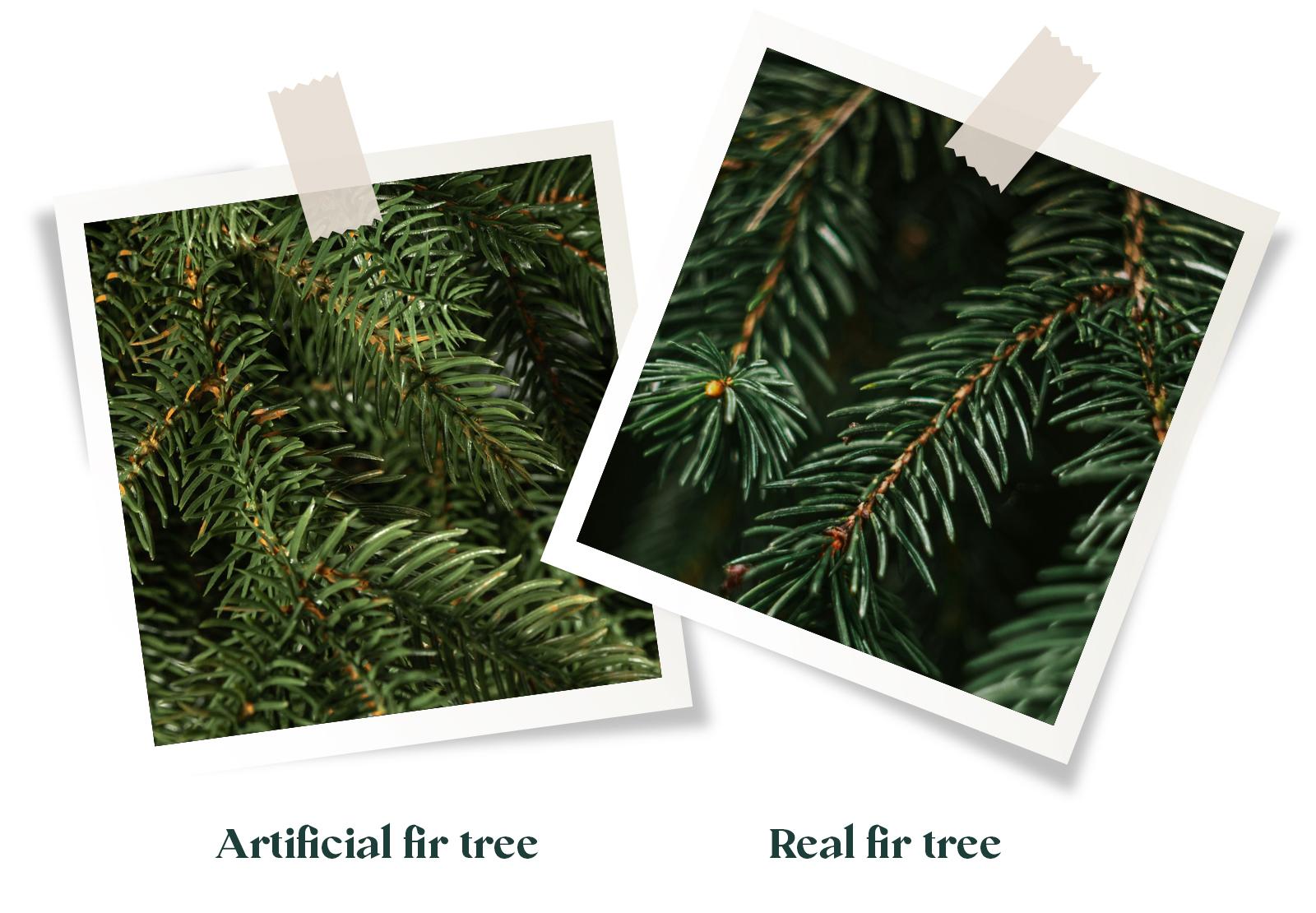
Some people know right away: they want a Christmas tree like those found in mountain forests - full, green and majestic. Others are looking for something lighter that will fit well into a cozy interior and won’t overwhelm the room. Thanks to the various inspirations in the FairyTrees collection, it's easy to choose a model that suits your style and way of celebrating Christmas. Each of them is based on the characteristics of real tree species to capture the atmosphere of the forest. How do you choose a nature-inspired artificial Christmas tree that suits both your home and your preferences? In this guide, we will show you the differences step by step: from needles to overall impression.
- An artificial pine tree delights with its light, airy appearance. Its needles are long and its branches are loosely spaced, creating the look of a natural woodland tree.
- Artificial spruce has a classic shape and dense, radially spread needles. It is associated with childhood and the traditional image of Christmas.
- Artificial fir trees (inspired by Nordmann firs as well as Alpine or Bavarian styles) are distinguished by their symmetry and softness. Depending on the style, they can be dignified, fresh, or very elegant, but always dense and pleasant to the touch.
Each tree has its own story. One brings to mind the snow-covered spruces of childhood, another the pine branches under which gifts were hidden, and yet another the dense, perfect fir trees of an Alpine slope. These associations are what inspire the FairyTrees collection.
Our offer includes a wide selection of artificial Christmas trees inspired by nature, so everyone can find the perfect tree for their home. But... how does an artificial pine tree differ from a spruce? How to recognize the Alpine style and how to recognize the Bavarian style? And what does the Caucasian fir inspire? This article is your guide through the ‘forest’ of Christmas trees, written with the attention we usually reserve for the most important Christmas choices.
Table of contents:
-
Why does the species matter when it comes to artificial Christmas trees?
-
Bavarian fir – the lighter, more versatile sister of the Alpine fir
-
How to choose artificial Christmas trees inspired by nature? A quick guide

Why does the species matter when it comes to artificial Christmas trees?
For an artificial Christmas tree to look realistic, it is not enough for it to simply resemble a tree. When designing the shape of a Christmas tree, it is important to pay attention to its counterpart in nature, and more specifically to elements such as:
-
the length and arrangement of the needles,
-
the shape of the crown,
-
the color scheme – all the way from deep greens to muted, bluish-green tones,
-
the form of the tree (is it slender, spreading, openwork, or perhaps very dense?).
Therefore, a pine tree inspired by nature will look different from a spruce, and an Alpine fir will look different from a Caucasian fir, even though they are all formally “just Christmas trees.”
Thanks to attention to detail and high-quality workmanship, artificial Christmas trees delight with their natural appearance, which is difficult to distinguish from a real tree. Artificial Christmas trees inspired by nature are made of the highest quality materials, such as PVC and PE, which ensures their durability and realistic and natural appearance.
The type of tree behind the design determines:
-
how much the tree will dominate the interior,
-
whether it will create a soft, blurred glow or a distinct outline of branches when lit,
-
how many decorations it can hold without looking overloaded,
-
whether it is more associated with an elegant living room arrangement or a forest cabin.
If you know what to expect from each type, you can consciously choose a tree: light, traditional and “forest-like,” or majestic and very dense. Artificial Christmas trees inspired by nature have the advantage that once you choose a style, it will stay with you for years. Choosing an artificial Christmas tree also offers several benefits, including convenience, durability, and a consistently realistic appearance year after year.
Pine – natural and a little “wild”
Pine is the kind of Christmas tree that looks as if it were growing at the edge of a forest - windswept and sunlit. A little rebellious, a little wild… It immediately reveals that it is closer to nature than to a perfectly styled catalog decoration. Artificial pines are suitable for both apartments and spacious interiors, offering convenience and ease of decoration. They also work well in smaller homes thanks to their light, space-saving structure.
What does a pine tree look like in nature?
A live pine tree has longer needles than a spruce or fir tree (usually 3-7 cm), gathered in bunches of two. They are stiff, slightly twisted, and can prick gently, but less aggressively than a spruce. Color? Gray-green or bluish-green, more often matte than shiny.
The crown of a real pine tree is loose, with distinct “layers” of branches. The needles accumulate mainly at the ends of the twigs, so the trunk and center of the tree are often visible. Older pine trees growing in open spaces can have a wide, umbrella-shaped crown with picturesque spreading branches.
How does this translate to an artificial pine tree?
An artificial pine tree inspired by nature looks light, does not overwhelm even a smaller living room, and is associated with wild nature and simplicity. Such a tree doesn’t overwhelm the room with greenery. It has a wider cone shape, but is not perfectly regular.
Pine trees are most often liked by people who:
-
like rustic interiors and natural materials (wood, linen, wicker),
-
prefer minimalist decorations – a few well-chosen decorations instead of heavy compositions,
-
prefer a tree that is not perfectly symmetrical, but has character.
Artificial pine trees also require much less effort to set up, shape, and maintain than real trees, making holiday decorating more convenient and hassle-free.
Decoratively, pine goes well with dried orange slices, wooden or plywood decorations, paper stars, and simple strings of lights without additional effects. Of course, it can be styled in any way you like – it works just as well in a glam or modern style. Garlands are also worth using for decoration, as they emphasize the magic of Christmas and allow you to enjoy the special atmosphere for a long time.
If you think, “I prefer the atmosphere of a forest cabin to a hotel lobby,” then pine is a very strong candidate for you. At FairyTrees, you will find the snow-covered pine tree FT04 – with delicately whitewashed branches and natural pine cones! Fluffy PVC ensures durability and a realistic look, and after the holidays, the tree is easy to dismantle and store, saving space and effort, so you can enjoy the Christmas atmosphere for many seasons.

Spruce – the traditional Christmas tree from childhood
You probably remember a spruce tree from your childhood. It’s the Christmas tree with rustling paper chains and glass baubles that jingle with every touch of the branches. FairyTrees artificial spruces delight with their charm and create the illusion of real trees, making them look extremely natural and authentic. These artificial spruces help create a festive atmosphere in your home, bringing warmth and celebration to your holiday décor. They have something of a winter forest and something very homely about them at the same time.
Spruce in nature
For many people, spruce is “the real Christmas tree.” Its needles are shorter (approx. 1-2.5 cm), very prickly, and arranged individually around the twig. It looks a bit like each shoot is a small, green “brush.” They often have a dark green, slightly shiny color.
Spruce trees are classic conical trees with a uniform appearance, making them a popular choice for Christmas. The branches are arranged in tiers, fairly regularly, and the top is slender and clearly defined. In mature trees, the lower branches begin to hang slightly, creating a characteristic shape.
Artificial spruce
Artificial spruces inspired by nature retain their slender, conical shape and have twigs with fine needles that create a “dense texture” effect. An important difference: in nature, spruce can be very prickly, but in the artificial version, this effect is only visual. The needles are soft, so you can safely decorate the tree even with children.
Spruce is a good choice if:
-
you are looking for a classic, traditional Christmas tree,
-
you prefer a slimmer silhouette than very wide fir trees,
-
you like your Christmas tree to look great even when it is not “overloaded” with decorations.
What to combine it with? Red baubles + gold accessories are a Christmas classic, glass decorations will beautifully reflect the light on a dark green background, and simple LED lights in a warm shade will emphasize its “forest” character.
If you want a Christmas tree in your living room that can be described in one word as “traditional,” the well-designed FairyTrees FT01 spruce made of soft PVC will hit the spot. You can decorate it in a classic or Scandinavian style. Looking for a more rustic look? Go for the exclusive FT02 spruce made of 100% PE, with a wild, irregular shape. All models are easy to assemble and store, ensuring everyday convenience.

Nordmann fir – the elegant queen of Christmas trees
The Nordmann fir looks as if someone drew the “perfect Christmas tree” and placed it in the living room. Its appearance is so realistic that it is almost indistinguishable from the real thing. It is even, dense, and dignified, with a surprising realism in its needle structure and overall look. It does not need many decorations to make it immediately clear who rules the Christmas scene.
What does the Nordmann fir look like?
The Nordmann fir is to the world of Christmas trees what an evening gown is to the world of fashion: elegant, refined, and impressive in its own right. It has flat, soft needles (about 2-3 cm long) that do not prick at all. They are arranged in two dense rows on the sides of the branch, like miniature leaves. It has a deep, dark green color with a sheen.
The crown of the Nordmann fir is very regular, conical, and full, with no large empty spaces between the branches.
Nordmann fir as an artificial Christmas tree
Inspired by nature, the artificial Nordmann fir looks impressive even without decorations thanks to its a spruce tree. Made of high-quality materials, it provides a natural and realistic look that is difficult to distinguish from a real tree. It has strong, stable branches that can handle heavy decorations. Most importantly, it creates the impression of a “full” Christmas tree in the room – lots of greenery, few gaps.
In practice, this means that you can hang a rich set of decorations on it, and in a larger room it will not be visually “lost” as it is sufficiently massive. The tree works well with both classic decorations (red, gold) and single-color arrangements (e.g., all in shades of white or silver).
The Nordmann fir will appeal to people who:
-
like elegance and symmetry, even branch lines, repetitive tiers, a beautiful contour from bottom to top,
-
prefer to choose a decent tree once and return to a proven look every year.
In the FairyTrees family of artificial Christmas trees inspired by nature, you can find as many as 5 different models of Nordmann fir:
-
Narrow FT05 made of a mix of PE and PVC, ideal for small rooms,
-
Premium FT06 made of 100% PE, with a beautiful shape,
-
Exclusive FT07 slim made of 100% PE with an umbrella unfolding system,
-
Bestseller FT14 made of soft and fluffy PVC,
-
Premium FT29 made of a mix of PE and PVC, with a regular shape.
The Nordmann fir can be used for many years, offering convenience and ease of decoration.

Alpine fir – monumental, dark, and extremely dense
Here we move into the world of styling. “Alpine fir” is not a botanical species name, but a term for the FairyTrees FT33 line of artificial Christmas trees, which imitate the magnificent fir trees of the Alpine forests. FairyTrees Alpine fir trees are distinguished by their impressive density and natural-looking branches, which make them look highly authentic
Characteristic features of FairyTrees Alpine fir trees:
-
The needles are soft, like those of a natural fir tree.
-
The color is usually very deep, dark, with a cooler green tone.
-
The branches are densely spaced, with virtually no gaps.
-
The base of the crown is wide and “bell-shaped.”
A typical Alpine fir has a wide base, creating the perfect place for gifts. It tapers towards the top but does not lose its density. This is the option for you if:
-
you have a larger interior and like monumental decorations,
-
you dream of a very dense Christmas tree where lights and decorations are “drowned” in greenery,
-
you prefer a darker, noble green instead of light shades.
Alpine fir goes well with red, gold, dark wood, and pine cones. Often, its silhouette and density alone make such an impression that you don’t need to overdo it with decorations. It’s also a good choice if you’re thinking of arrangements in the spirit of classic elegance: heavier baubles, burgundy, thick textiles. Against the backdrop of dark Alpine fir, all of this looks exceptionally impressive. Thanks to the durability of these trees, you can enjoy the magic of Christmas and a naturally beautiful Christmas tree for many seasons. Investing in an Alpine fir artificial Christmas tree pays off in the long run, as its lasting beauty and sturdy construction provide excellent value year after year.

Bavarian fir – the lighter, more versatile sister of the Alpine fir
The Bavarian fir (like the Alpine fir) is a style of Christmas tree, not a botanical name – it refers to the fir forests of Bavaria. FairyTrees FT32 artificial Christmas trees are similar to Alpine firs, but with a few key differences.
What makes FairyTrees Bavarian fir trees special?
-
The needles are soft, but their green color is lighter and fresher.
-
The tree looks like a young, healthy fir tree in a well-lit forest.
-
The silhouette is narrower, more home-friendly silhouette: it is easier to fit into a typical living room.
You can also gently shape the Bavarian fir by bending the branches more upwards or sideways. This allows one Christmas tree to be adapted to a narrower or wider setting. This tree is for you if:
-
you want the effect of a natural fir tree, but in a lighter version,
-
you need a compromise between a full, dense fir tree and a slightly lighter spruce,
-
you prefer a Christmas tree that invites shared decorating.
The lighter green of the Bavarian fir goes well with eco-friendly decorations (paper, wood, string), natural zero-waste decorations, and delicate LED lights that look like little fireflies on the light-colored needles.

How to choose artificial Christmas trees inspired by nature? A quick guide
Finally, let’s get down to business. If:
-
you like lightness and a rustic atmosphere → choose a pine tree. An openwork silhouette, longer needles, more “air” between the branches. These artificial trees are easy to set up and pack away, and require minimal effort or maintenance.
-
you dream of a Christmas tree like the one from your childhood → go for a spruce. A slender cone, small needles, a delicately irregular, very natural look.
-
you are looking for an elegant, very dense Christmas tree for your living room → Nordmann fir. Dark green, perfect cone, full silhouette, strong branches. These are some of the best artificial Christmas trees for realism, with remarkably realistic PE and PVC needles.
-
If you have a lot of space and like monumental decorations → Alpine fir. Wide base, dark, deep green, “mountain forest” effect in your home. These artificial trees enhance the holidays with their impressive presence and are designed with safety in mind.
-
If you need a versatile tree for most interiors → Bavarian fir. Lighter green, slightly slimmer shape, great base for natural decorations. These models are affordable and easy to assemble, with a stable bottom section and minimal maintenance required.
Artificial trees like these are a great choice for the season, offering durability, safety, and a realistic look without the hassle of watering or excessive maintenance. Be sure to check stock and order early, as the best artificial Christmas trees tend to sell out quickly before the holidays.