
Protecting Christmas Tree From Dogs: A Guide to a Peaceful and Safe Christmas for Your Dog
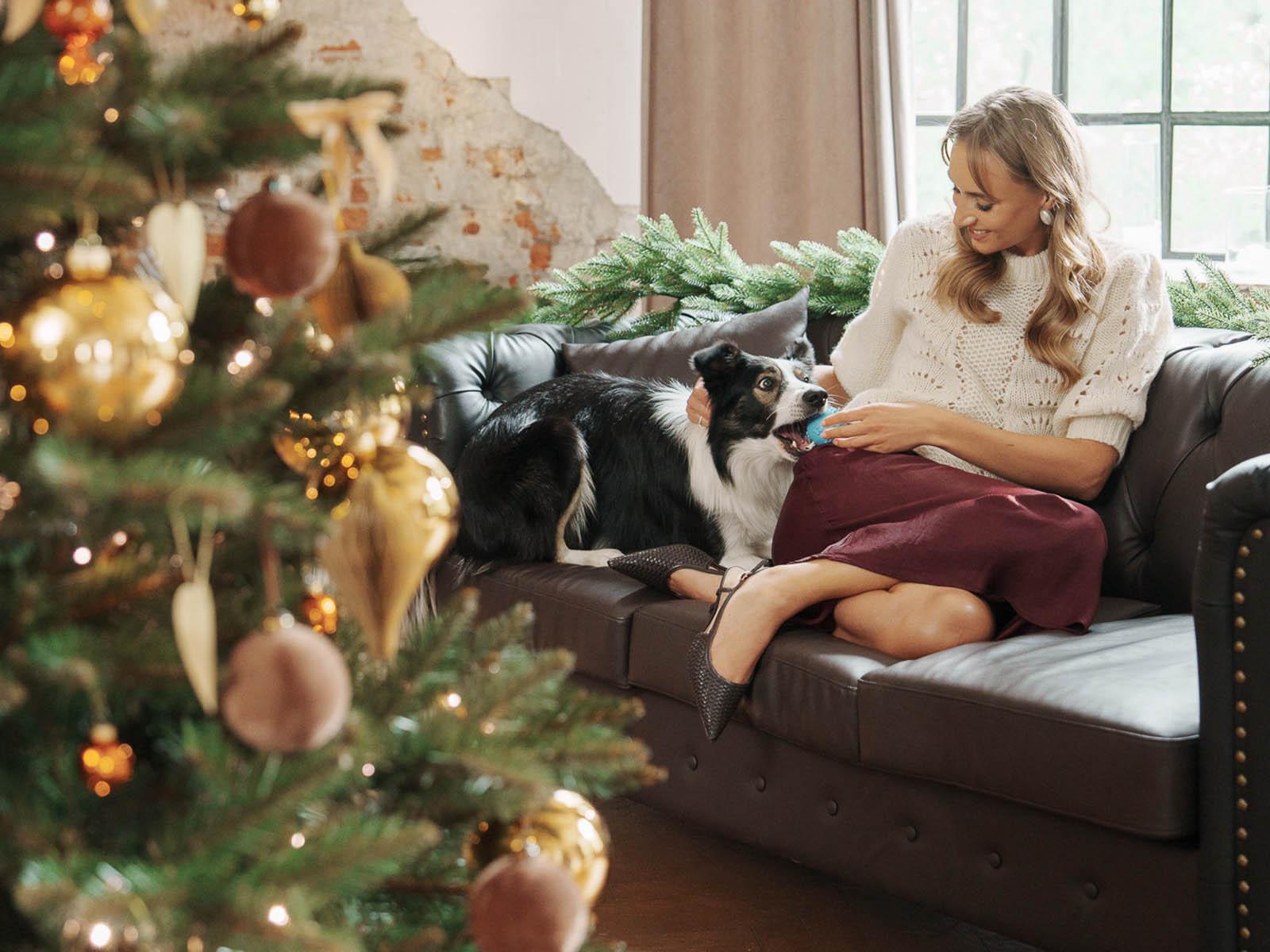
Christmas tree versus dog – this clash may look funny in memes, but not in real life. In reality, a knocked-over tree, chewed lights, and decorations scattered all over the living room can effectively take away the magic of Christmas. Fortunately, this can be avoided if we properly prepare for a typical problem that arises in a home with pets, including learning how to make your tree dog-safe to prevent accidents.
Many dog owners are worried about putting up a Christmas tree in their living room. Especially when they have an energetic Labrador, a curious puppy, or a tail-wagging enthusiast of every new smell living in their home. And although an artificial Christmas tree has many advantages, without proper preparation, it can fall victim to canine exploration. How can you protect your Christmas tree from your dog so that neither the tree nor your four-legged friend suffers? Implementing dog-proofing strategies and preparing a dog-safe Christmas tree are key steps to ensuring a safe and happy holiday season.
- The tree stability is essential! A sturdy stand, wall mounting, and proper positioning significantly reduce the risk of the dog knocking over the Christmas tree.
- Restricting access is often the best solution. A christmas tree fence, a pet gate, or closing the door to the room with the Christmas tree work great, especially with puppies.
- Choosing the right Christmas tree and decorations is very important. Not all ornaments are safe for dogs. It is better to choose unbreakable decorations that are not too visually appealing and placed out of reach. It is also worth considering special accessories such as cable covers, non-slip mats, or stand guards to help protect the tree from animals.
It was meant to be a peaceful Christmas Eve. But suddenly – a rustle, a thud, a clatter. And you know what happened: the dog “took care” of the Christmas tree. This is a typical problem faced by pet owners during the holiday season.
If you’ve ever come back to your living room and seen the tree leaning to one side, with your dog triumphantly wagging its tail in the background, this article is for you. Or even better, if you want to prevent this before you even decorate the tree. You can’t forget about the safety of all your pets during the holidays.
Artificial Christmas trees are practical and durable, but they are still not immune to claws, teeth, and the excessive enthusiasm of a four-legged friend. Proper preparation, including dog-proofing and using pet friendly options, is your chance for a peaceful holiday without stress and loss. Here is a complete guide on how to protect your Christmas tree from your dog and prepare for the holidays.
Table of contents:
-
Christmas tree placement and stability – how to prevent it from falling over?
-
Lights and cables vs. dog teeth. How to protect the cables and keep your dog safe?
-
Can scent discourage a dog from approaching the Christmas tree?
-
What kind of artificial Christmas tree should you choose for a home with a dog?
-
Christmas tree decorations and dogs – what is safe and what should be avoided?
-
How to match Christmas tree safety measures to your dog’s personality?

Christmas tree placement and stability – how to prevent it from falling over?
A safe artificial Christmas tree is one that cannot be knocked over by a dog’s paws or tail. It is worth thinking carefully about its placement before the first bauble is hung on a branch. Find out what to do to avoid Christmas “disasters.” Here are some essential safety tips for placing and stabilizing your Christmas tree to help keep your pets and home safe during the holidays.
A sturdy stand and a weighted base
The first line of defense is a sturdy stand. The wider the base and the heavier the construction, the lower the risk of the tree tilting or falling over. Instead of a lightweight plastic stand, it is better to choose a good-quality stand right away. At FairyTrees, we make sure that our wooden stands are really sturdy, which is why we make them from solid wood.
If the tree still wobbles, it is worth weighing it down. All you need is a few bags of sand or training weights, hidden under the tree's “skirt.” Aesthetic and effective.
Attaching the tree to the wall or ceiling
For particularly energetic dogs, weighting alone may not be enough. In this case, transparent fishing line and a discreet hook in the wall or ceiling come in handy. Simply attach the top or trunk of the tree with fishing line, which is practically invisible. Alternatively, the tree can also be tied to a curtain rod, which will further increase its stability and prevent it from falling over.
This attachment acts as a safety belt: even if your dog trips over something, jumps under the tree, or suddenly runs into it, the tree will not follow. And you won't have to pick up decorations from under the furniture afterwards.
The best place for a Christmas tree in a home with a dog
Choose corners of rooms, alcoves, and spaces between furniture where the tree can find natural support. Places that allow you to attach the tree to the walls with string get extra points. Avoid placing the tree near the sofa, as it may become a target for jumping or… napping on a branch.
Remember that the location of the tree in your home matters. A Christmas tree placed where your dog usually runs, sleeps, or plays is like a trap. Curious pets are more likely to investigate trees set up in their usual play areas, increasing the risk of accidents with ornaments or decorations. One crazy dash across the living room and the baubles will fall like dominoes. It is also a good idea to designate a safe place for your dog away from the Christmas tree to ensure peace and quiet during the holiday preparations and to protect them from the stress of decorating and visiting guests.
Choosing the right tree height for your dog
The height of the Christmas tree really makes a difference. From a dog's perspective, it's a question of “can I reach it or not?” When choosing a tree, it's worth considering not only the interior design, but also... the length of your dog's snout. Here's a handy guide:
-
120 cm Christmas tree – for a medium-sized dog, it is the perfect “floor toy.” Easy to knock over with a paw, tail, or nose. Without additional security measures, it may fall victim to curiosity.
-
150 cm Christmas tree – the golden mean. It looks good in most living rooms, and at the same time, it can be placed on a solid stand and anchored. For most dogs, this is already a challenge, not a toy.
-
180 cm Christmas tree – looks impressive, but requires stronger fastening, especially with larger dogs. It reaches lower, so the lower branches should remain empty or trimmed.
-
220 cm Christmas tree – beautiful, but difficult to secure in the presence of a very energetic dog. It requires special care: a solid base, anchoring, and a very well-thought-out location.
The taller the tree, the more it weighs – but also the greater the impact if it falls over. Therefore, a tall tree should be a really well-considered choice. And if your dog has a “tail like a fan,” it's worth raising the tree above its reach. It doesn't have to be a coffee table. A stable platform, such as a chest, a low platform, or a solid chest of drawers, will suffice to help keep the branches away from unwanted contact. A dog knocking over a tall Christmas tree can result not only in the destruction of decorations, but also in injury to the animal.

How to restrict a dog's access to the Christmas tree?
Not every dog will destroy a Christmas tree – but any dog can do so if no one stops it. That is why it is worth thinking in advance about securing the space around the tree. Pet proofing options such as barriers, gates, and fences can help restrict access to the tree. This protects the decorations, gives the owner peace of mind, and ensures the safety of the pet itself.
Fences, barriers, and protective gates
A physical barrier is one of the simplest and most effective ways to protect your Christmas tree. It works especially well with young dogs.
There are several options to choose from:
-
baby gates or modular playpens that can be arranged in any shape,
-
decorative fences that do not spoil the look of the living room and can even become part of the Christmas decor,
-
dog pens, available in various sizes and colors.
It is important that the fence is sufficiently high, stable, and positioned in such a way that the dog cannot reach the decorations with its mouth through the gaps. This is a simple way to allow the dog to see the tree but not have access to it.
Christmas tree in a separate room or “supervised area”
Securing the Christmas tree should also include placing it in a hard-to-reach place. If you have a room with a door in your home, it is worth using it as a Christmas “restricted access area.” A closed door, even if only during your absence, is a very effective security measure.
However, it is not always possible to completely separate spaces. In such a situation, a so-called supervised zone works well. This is a place off the dog's running route, away from its favorite toys or observation points. This reduces the risk of the dog knocking over the Christmas tree in the heat of everyday excitement.

Lights and cables vs. dog teeth. How to protect cables and keep your dog safe?
Flashing lights can be delightful, but from a dog’s perspective, they are often something between a toy and prey. Hanging cables resemble strings, and delicate lights can encourage chewing. Christmas lights, electrical cords, and exposed wires all pose risks to dogs, including the dangers of chewing, tripping, electrical shocks, and even fires. Therefore, it is worth considering how and where to install the lighting on the Christmas tree so that it does not tempt or endanger your four-legged family member. Remember to secure Christmas tree lights and cables properly and keep them out of your dog’s reach – damaged wires can lead to serious hazards such as electric shock or burns.
Hiding and securing light cables
The biggest danger is not the lights themselves, but what hangs from them. Wires stretching across the floor or hanging loosely from branches are something a dog can grab with its teeth or get tangled up in with its paws. From there, it's only a step away from damaging the lights or, worse, getting an electric shock.
To avoid this:
-
route the cables along the walls, behind furniture, or along baseboards,
-
attach them to the floor or furniture legs with tape,
-
hide excess wires, e.g., in a decorative box under the Christmas tree or under the Christmas tree “skirt.”
The fewer loose, hanging elements, the less temptation for your dog.
Cable covers and lights in protective tubing
For dogs that like to chew on anything that resembles a string, precautions alone may not be enough. This is where protective tubes come in handy – flexible, transparent covers that are placed over cables. Thanks to them, the dog has no direct contact with the wire.
An alternative is lights in a silicone “hose,” i.e., ready-made sets where the entire installation is enclosed in a single flexible tube. They are more difficult to chew through, less inviting to play with, and much safer.
This extra layer of protection can be crucial, especially with young, curious dogs.
Battery-powered LED lights and dog safety
When it comes to lights in a home with a dog, it is worth choosing a LED model powered by batteries. Not only because it does not heat up – although this is a huge advantage. Above all, because it does not need to be plugged into a socket, so there is no need for long cables.
Battery-powered lights are:
-
easier to secure,
-
safer in case of damage,
-
more flexible in installation (they can be mounted, for example, only on the top of the Christmas tree).
It is a good idea to hide the battery container, e.g., behind the tree or in a decorative box.
For additional festive ambiance, consider using LED candles as a safe, flameless alternative to traditional candles.
Do we need to turn off the lights when we leave the room?
Yes. Always. This is one of those simple Christmas rules that’s truly worth following. Even the best-secured installation can be damaged, and if a dog is left alone with flashing lights, it may decide to investigate them.
When you leave the house or go to bed, unplug the lights. Don't leave them unattended – this reduces the risk of electric shock, chewed cables, and even fire. Plus... you'll sleep better knowing that everything is under control.
See also other ways to protect your Christmas tree from your dog in the following chapters.
Lights safely out of your dog’s reach
The simplest solution is often the best: do not install lights where your dog can reach them. It's better to leave the lower parts of the tree without lights. After all, you don't need to light up the whole tree. Even if the lights start halfway up, the tree still looks impressive – and you have peace of mind. For a dog looking up from below, it's simply an invisible zone.

How to teach your dog to ignore the Christmas tree?
A properly secured Christmas tree is one thing, but a dog that knows how to behave around it is another level of holiday peace of mind. Ultimately, even the best stand and barriers cannot replace training and working with your pet. Training is especially important to prevent situations where a dog eats decorations, gifts, or other hazardous holiday items. The good news? Dogs can really be taught to treat the tree as if it were air – treats will be helpful here as an effective reward when teaching them to ignore the Christmas tree.
The “leave it” and “don't touch” commands in practice
These are the two most important commands in the December repertoire. “Leave it” and “don't touch” act as a safety net. If your dog knows what they mean and responds to them without hesitation, you are a few steps ahead.
It's best to start simple: throw a treat or toy, and when the dog approaches, say “Leave it.” The dog should be rewarded with praise or another treat. Once your pet understands what the game is about, move the training to the Christmas tree area.
Don't wait until your dog starts getting ideas – react immediately before it makes contact with decorations or cables! It's a good idea to start observing your dog from the moment you set up and decorate the Christmas tree. It is a good idea to let your dog sniff the tree and use the command “leave it” or “don't touch” as soon as your pet tries to grab a branch with its mouth.
Rewarding your dog for calm behavior around the Christmas tree
Instead of just prohibiting, it is also worth rewarding desired behaviors. Is your dog lying quietly next to the tree? Is it ignoring it, even though a new bauble has just been hung? This is the moment for praise, a treat, or a moment of play together.
Don't let your dog associate the Christmas tree with prohibitions and frustration, but rather with an opportunity to... get something good for good behavior. You are building a positive pattern that will last longer than one season.
Toys, chews, and snuffle puzzles as distractions
A dog with nothing to do will find something else to do. And if a lit Christmas tree becomes the centerpiece of the living room, the choice is obvious. That's why it's important to provide your dog with an alternative, especially in the first few days after putting up the tree.
The following are ideal:
-
strong chew toys (natural, e.g., made of cotton rope or rubber),
-
toys filled with treats,
-
snuffle mats, and food-puzzle toys.
Gradually familiarizing your dog with a new element in the home
The Christmas tree does not have to appear in the house “ready for action.” On the contrary, for a dog, a Christmas tree is a strange, unfamiliar object, so it is worth giving them time to get used to its very existence. Many owners imagine a peaceful Christmas with their dog, but this requires proper preparation.
It is a good idea to put up a sparsely decorated tree for a day or two, preferably on the weekend or during a few days off, so that you have time to observe. Your dog may sniff the tree, walk around it, and... lose interest. Only then should you start adding decorations, lights, and presents.
If you don’t teach your dog appropriate behavior, it may end up doing something undesirable, such as knock over the tree or destroy the decorations. Small decorations can be swallowed by the dog, which poses a serious threat to its health. Some sharp decorations can also cause pain if the dog injures itself on them.

Can scent discourage a dog from approaching the Christmas tree?
For a dog, the world is primarily about smells. If something smells intriguing, it needs to be checked out. If it smells too intense or unpleasant, it's better to stay away. And this is precisely what you can use to build another layer of protection around your Christmas tree.
Natural scent barrier
Most dogs don’t like the smell of citrus. For us, it’s a pleasant freshness, but for a dog, it’s a much too intense and irritating aroma. It’s worth taking advantage of this, especially around the lower branches of the Christmas tree.
What can you do?
-
Prepare scented sachets with the scent of citrus and cloves.
-
Use citrus decorations – but only those that do not contain essential oils (they may be too intense) or dried fruit (citrus fruits are poisonous to dogs). Avoid using dried orange slices as decorations, as they are a traditional holiday item but can pose a risk to pets if ingested.
Spraying the Christmas tree with water mixed with vinegar or pepper acts as a natural deterrent for dogs. The smell is no substitute for a barrier or training, but it can be a gentle signal that “this is not the place for you.” In addition, it works in a way that is natural for dogs and does not cause aggression or fear.
Bitter spray on the stand and cables
Pet stores sell so-called bitter sprays, designed to discourage dogs from chewing on objects. They work by having a very unpleasant, bitter taste that discourages the dog after the first contact.
You can spray them on the Christmas tree stand, protect the cables from the lights or decorations that the dog tries to chew on.
What kind of artificial Christmas tree should you choose for a home with a dog?
Not every artificial Christmas tree is suitable for a home with a dog – and it's not just about stability. It is equally important how it looks, how it is made, and whether it will act like a huge, shiny toy for your dog. A well-chosen artificial Christmas tree can effectively discourage your dog from exploring. So what should you look for?
-
Choose matte needles instead of glitter and artificial snow. The less sparkle, the fewer problems. Artificial Christmas trees with intense shine, glitter particles, or artificial snow are not only more attractive to dogs, but also... potentially dangerous. Some dogs try to lick or chew on anything that shines.
-
Some artificial PVC Christmas trees can lose their needles, so vacuum the area around the tree every day. Dogs may not be able to distinguish between needles and treats, especially if they are lying next to their toys or food bowl. Dogs can eat Christmas tree needles, which can lead to stomach problems such as vomiting. Fortunately, serious health problems after eating Christmas tree needles are rare, but it is always a good idea to regularly clean up fallen needles from the tree to prevent your dog from eating them (and to take care of its delicate digestive system).
-
Only decorate the top of the tree. This is a simple trick that really works. The lower parts of the tree remain undecorated, and stylish decorations are placed only above the level of the dog's snout. You can use natural light and hang more lights at the top, as well as use decorations in one color scheme to maintain a sense of symmetry.

Christmas tree decorations and dogs – what is safe and what should be avoided?
Poorly chosen Christmas tree decorations can cause your dog to treat the tree like a new set of toys. That’s why the choice of baubles, chains, and pendants should be well thought out. First of all, avoid glass ornaments and non-edible decorations, which can easily break or be chewed on and pose a threat to pets. For a dog, anything that hangs, sparkles, smells, or moves is potential prey. And for you – a risk of cuts, poisoning, or swallowing something that should not end up in your dog’s stomach.
When considering safe alternatives, opt for thread-based decorations, which are pet-friendly and less likely to cause harm if your dog gets curious.
Be cautious with food based decorations, such as traditional food decorations and candy canes, as these can tempt pets to snack on them and may be hazardous.
Additionally, avoid other non-edible decorations that could be mistaken for treats, as these also pose safety risks for your dog during the holidays.
Unbreakable baubles instead of glass
Glass decorations are a classic, but unfortunately, they are also a classic hazard. One wag of the tail or one nudge with the snout is enough for glass baubles to fall to the floor and shatter into sharp pieces. For a dog, this is not only noise, but also temptation: something new is happening, maybe it's worth checking out?
Instead, it is better to choose:
-
plastic baubles – lightweight, unbreakable, often just as impressive,
-
decorations made of felt, wood, or fabric – they look natural, and even if they fall, nothing will happen.
It is also worth remembering that decorations that hang loosely from branches can particularly attract a dog's attention and provoke it to play. Therefore, it is best to hang them higher so that it cannot reach them with its mouth, or choose decorations that are less likely to be knocked off easily.
Decorations with high sentimental value should be placed on the higher branches of the Christmas tree to protect them from damage by animals.
Ribbons instead of metal hooks
Metal hooks for baubles and decorations are best replaced with fabric ribbons, string, or stronger thread. In addition, if you tie the decoration securely, it will be more difficult to knock it off, even if the branch is bumped harder.
Classic metal hooks are quick to use, but just as quick to fall off. And when they land on the floor, they become an interesting, shiny object for your dog – exactly the kind that is worth grabbing with its teeth. What's worse, they are thin and sharp.
Place decorations out of reach of your pet's the mouth and tail
Hanging decorations is a bit like planning a museum space with a small child – anything that can fall should be placed higher up. So if you have a pet that is constantly wandering around the living room, make sure that the lower parts of the tree remain “boring” for them. How can you do this?
-
Hang the prettiest and most delicate decorations higher up, out of reach of your pet and its tail.
-
Leave the lower branches empty or decorate them with ornaments that are completely non-toxic and harmless, even if your dog gets to them.
-
Avoid hanging anything that resembles a toy or treat.

Why tinsel, angel hair, and small gadgets are risky
Tinsel, angel hair, shiny threads, and plastic beads may look beautiful in the glow of the lights, but they often end up on the floor. And a dog doesn't need a special reason to “clean them up.”
Swallowing such decorations can lead to gastrointestinal irritation, intestinal blockages, and, as a result, costly veterinary interventions.
The smaller and shinier the decorations, the greater the risk. If you want to use such details, hang them high or... just give up this year.
Edible Christmas tree decorations – why not with a dog
Gingerbread cookies, candies, chocolates, popcorn, dried fruit – it's a beautiful tradition. But with a dog? A recipe for disaster. Especially since a dog's nose can smell sweet decorations even through paper, foil, and a layer of icing. Avoid hanging edible decorations on the Christmas tree to prevent digestive problems in your dog.
Edible decorations are problematic for many reasons:
-
your dog may literally throw itself at the tree to get them,
-
chocolate is toxic to dogs – even a small amount can be harmful,
-
strings, foil, and paper can be more dangerous than the contents themselves.
Instead of taking the risk, it is worth choosing decorations that look like they are edible, e.g., made of felt or wood, which imitate gingerbread and lollipops. They look beautiful but are completely neutral for pets.
A safe Christmas tree environment: gifts, tidiness, plants
The Christmas tree is not everything – what happens around it is just as important! And in December, a lot happens: gifts, decorations, ornaments, and sometimes even live plants appear. For a dog, it’s a real festival of stimuli: something new, something fragrant, something shiny. That’s why it’s important to know how to keep things tidy and safe at the base of the Christmas tree.
Here is a list of golden rules to remember during the Christmas season.
-
Don’t leave gifts under the tree too early, especially if they contain something fragrant (sweets, cosmetics, spices). Packages under the tree can look tempting even to a well-behaved dog, so it’s better not to test its willpower. Many families follow the tradition of waiting until Christmas morning to open presents, which not only adds to the excitement but also helps keep pets safe by keeping gifts hidden until then. Keep gifts in a safe place, out of your dog’s reach, to avoid them being damaged or unwrapped by your curious pet.
-
Remember that your dog may treat your Christmas tree like… a regular tree and want to mark its territory. Therefore, if you don’t want your Christmas tree to become a “notice board” in dog language, make sure you take your dog for more frequent walks (especially in the morning and evening) and be sure to observe its behavior around the tree. If it sniffs intensely at the base, stop immediately and take it outside. And if an incident does occur, be sure to clean the Christmas tree thoroughly. You can also spray it with a special enzymatic spray that removes not only the smell but also the dog’s “mark.”
-
Be careful with toxic Christmas plants, especially poinsettias, mistletoe, holly, ivy, yew, and other conifers in decorations. Some are poisonous even in small amounts. Ivy and poinsettias are popular Christmas decorations, but they can be dangerous to pets – both when ingested and when in contact with the skin. The same applies to spray decorations: artificial snow, paints, and glitter can irritate the mucous membranes or cause allergic reactions.
How to tailor Christmas tree safety measures to your dog's personality?
There is no one-size-fits-all strategy that will work in every home, especially when it comes to dogs. Each animal requires an individual approach to Christmas tree safety – what works for a phlegmatic and somewhat lazy dog may prove completely inadequate for an energetic puppy or a curious mutt.
It is worth choosing Christmas tree protection methods not only according to its appearance, but above all according to the personality and age of the dog:
-
A puppy sees the Christmas tree as a new world to discover. Twigs, baubles, lights, boxes of presents – everything is a toy. And unfortunately, everything can end up in its mouth. In this case, you need a full security package: a sturdy stand, barriers, decorations only at the top of the tree, hidden cables, and full control of the environment.
-
An adult dog may behave calmly – or quite the opposite. If it has not had any previous contact with a Christmas tree, it may try to mark it, sniff it, or test the reaction of the household members. The key here is to combine safety measures with training. Commands, rewards, supervision, and a lot of consistency. Depending on the nature of your pet, you have various options for securing your Christmas tree – from physical barriers, to choosing safe decorations, to restricting access to decorations.
-
Senior dogs usually no longer have the energy for Christmas madness, but… they may accidentally knock over the tree, catch it with their tail, or step on a cable. The most important thing here is the stability of the structure and minimizing risks in the lower area.

One dog, many possibilities, so get to know your dog and choose protection based on its behavior, not its age. Christmas is a time of excitement – for dogs too. More people in the house, new smells, more intense lights and sounds. All of this can upset even the most well-behaved pet. So it’s a good idea to introduce dog Christmas rituals that help them calm down:
-
daily “gifts” in the form of a chew toy, interactive toy, or licking mat,
-
a short training session by the Christmas tree, ending with a treat,
-
evening relaxation in their bed, with a blanket and chew toy.
You can also agree with your household members that the dog gets a reward for every calm pass by the tree. Then the Christmas tree ceases to be a forbidden place and simply becomes part of their space. Take care of your dog’s comfort by providing them with enough exercise so that they are less likely to misbehave around the Christmas tree.
Observe your pet’s behavior in the context of Christmas decorations and respond appropriately. With patience and the right approach, you can ensure a joyful holiday season for both you and your pet. Remember to dog-proof your Christmas by adapting these strategies to your dog's unique needs and potential hazards.