Christmas Tree with cats in the house: how to protect it?
Bright, fragrant, full of shiny decorations and tempting branches... For a cat, a Christmas tree is an incredible attraction, and for its owner, a considerable challenge — especially during the festive period, when extra decorations and activity can make things even trickier for cat owners. Cats love Christmas trees due to their natural curiosity and instinct to explore new, high spaces. Every December, many people ask themselves the same question: how to protect your Christmas tree from your cat so that it doesn’t end in disaster? Fortunately, there are a number of clever and proven ways to enjoy the holidays without stress. Both for you and your pet! To cat-proof your Christmas, you need to take specific steps to keep both the tree and your feline friend safe.
-
Choose the right artificial Christmas tree and position it well. A smaller tree, a solid base, and good anchoring significantly reduce the risk of it falling over. Try to choose models that are stable and resistant to cat mischief.
- Make sure your decorations and lighting are safe. Unbreakable decorations, no tinsel, and secured cables are the basis of a cat-proof Christmas tree. You know how important it is not to leave easily accessible, dangerous items lying around. During the festive period, making your home cat-safe is essential to prevent accidents and keep your pet relaxed.
- Give your cat an alternative and set clear rules. A scratching post, mini Christmas tree, or playtime at the right time will satisfy their need to explore.
Some cats ignore Christmas trees completely, while others will use them as a base camp or climbing training ground. If your pet is one of the more curious ones, it's worth taking preventive measures. It's almost impossible to imagine Christmas without a Christmas tree, even if you have a cat at home. An artificial Christmas tree can be much safer than a real one, but only if you choose, set up, and secure it properly.
Table of contents:
-
How to prepare an artificial Christmas tree so that your cat doesn't knock it over?
-
What kind of Christmas tree should you have if you have a cat at home?
-
Securing the Christmas tree so that the cat cannot knock it over
-
Where to place the Christmas tree so that the cat has difficulty accessing it
-
How to restrict the cat's access to the Christmas tree when you are not at home?
-
Why is it a good idea to put up an artificial Christmas tree without decorations for a few days?
-
-
What to do to prevent cats from attacking the Christmas tree?
-
How to teach your cat that the artificial Christmas tree is off-limits?
-
What to do to prevent your cat from climbing the Christmas tree? Attractive alternatives for cats
How to prepare an artificial Christmas tree so that your cat doesn't knock it over?
Some cats ignore Christmas trees throughout the holidays. Others will turn it into a home playground before you even have a chance to hang the first bauble. The traditional Christmas tree is an essential part of holiday decorations, but it can be a challenge for cat owners – especially if your cat decides to climb the tree. It’s a bit like a holiday ritual: when the tree appears in the room, the cat begins its own test of the tree’s durability and its owner’s patience.
Therefore, before you spread out the branches and start planning the decorations, it is worth taking the necessary precautions to avoid the problem of protecting the Christmas tree from your cat. And it’s not just about the appearance! It's important to cat-proof your Christmas tree against feline curiosity to prevent accidents or damage during the festive season.
What kind of Christmas tree should you have if you have a cat at home?
An artificial Christmas tree is a much better choice for a home with a cat than a live one. Real trees, such as firs and pines, are mildly toxic to cats and may contain pesticides or plant food, which can be harmful if ingested. The oils produced by real Christmas trees can also be toxic to cats if they lick or chew the branches. Additionally, the water used for a real tree – often called tree water – may contain plant food or fertilizers, and if a cat drinks this water, it can be dangerous. Real Christmas trees can pose additional hazards compared to artificial ones, including the risk of cats drinking contaminated tree water and exposure to toxic substances. A live tree loses needles, which can get stuck in the pads of the paws or, worse, be swallowed (eating needles from a natural Christmas tree can expose the cat to stomach problems and mechanical damage to the digestive tract). In addition, natural Christmas trees are often placed in water with fertilizer, which can be toxic to animals.
An artificial Christmas tree, purchased once every few years, is a safer option for cats than a natural one. FairyTrees artificial Christmas trees have soft needles, do not emit irritating odors, and are more predictable in their “construction,” which makes them much easier to secure.
Also consider purchasing a smaller Christmas tree. Lightweight, compact models have the advantage that even if they are knocked over, they will not cause much damage. They are also easier to place in hard-to-reach areas, which can be helpful if your cat is one of the more agile and stubborn ones.
The base is just as important as the tree itself. Models with a solid wooden base (such as those offered by FairyTrees) provide greater stability and resistance. Solid wood is heavier, less prone to movement, and does not “dance” across the floor when a cat catches a branch.
Stable base, additional weight, and heavy stand
No Christmas tree – even the most beautiful and smallest one – will be safe if it is not standing on a suitable stand. If you have a cat at home, it is worth securing the tree against tipping over – for example, by attaching it to the wall or using a heavier base to prevent it from tipping over while your pet is playing. If the stand seems too light (as is the case with many models available in stores), it is worth considering adding weight. All you need is a bag of sand, which you can hide under the Christmas tree skirt, or a decorative box with something heavy inside. Cats are less interested in something that doesn't move when they bump into it, and a stable Christmas tree base doesn't give them that thrill.
Metal stands can be sturdy, but they often have slippery legs, so wood, especially solid wood, works much better. Natural material not only grips the ground better, but is also less prone to tipping. A well-chosen base means less stress and more peace of mind – for both your cat and you.
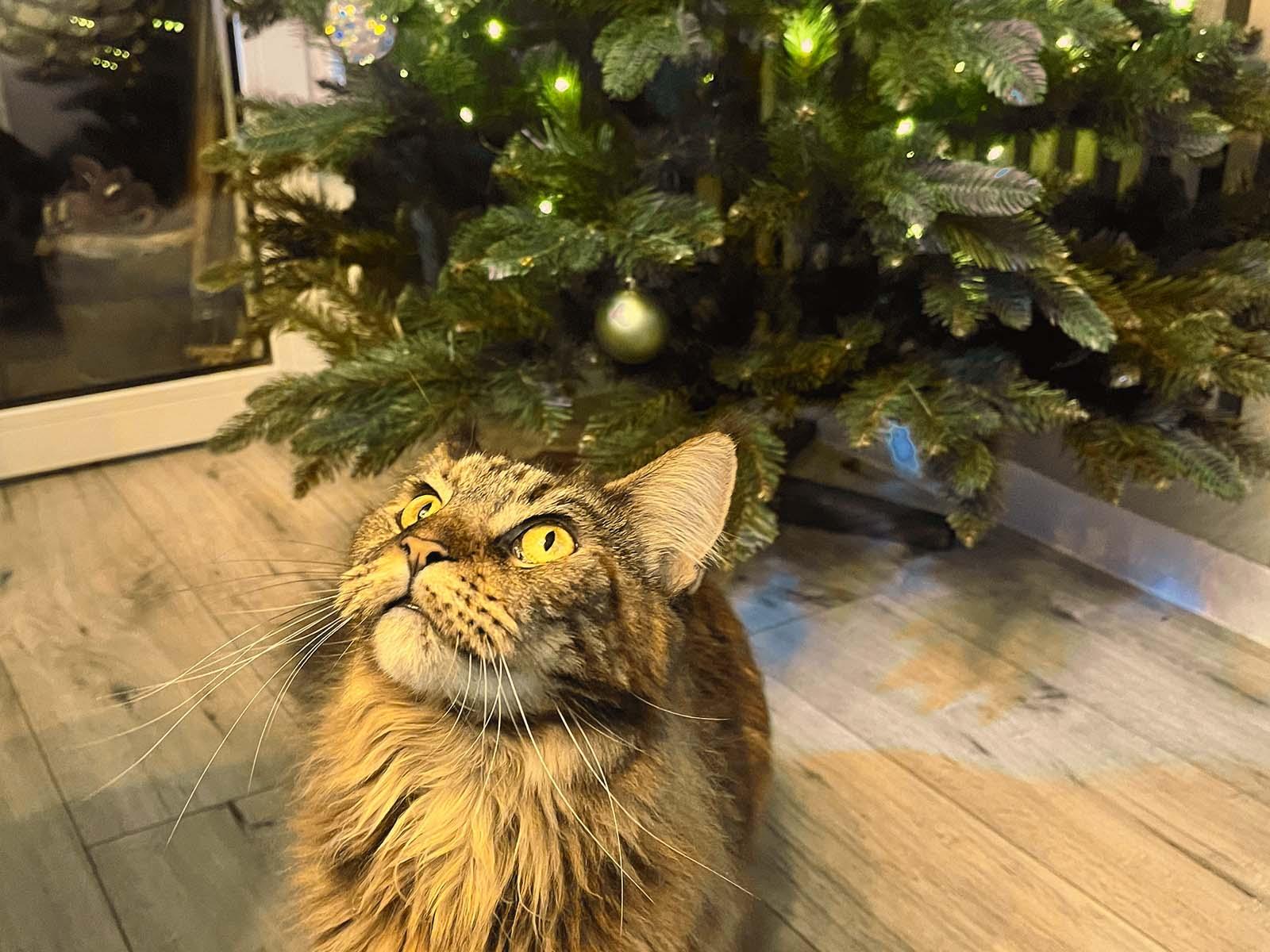
Securing the Christmas tree so that your cat cannot knock it over
Even the best-chosen Christmas tree may not withstand a surprise attack – especially if your cat likes to climb enthusiastically. In this case, it is worth considering additional protection for the tree by anchoring it.
Before securing the tree, identify and minimize launching zones – areas where cats can jump onto the tree from nearby furniture, shelves, or other elevated surfaces. Reducing these launching zones will make it harder for your cat to access the tree in the first place.
The easiest way is to attach the tree to the ceiling or wall with fishing line. It is transparent, durable, and difficult to see. All you need is a self-adhesive hook or a small eyelet screwed into the wall to create an invisible “safety line” that will keep the tree upright even if it is hit hard. In addition, it is worth ensuring that the top of the Christmas tree is not easily accessible to the cats – avoid decorations that may attract them and make sure that the top is not an easy target for play.
It is important that the string is taut – this is especially important during installation, which should be done carefully and without frustration. If it is loose and starts to move, your cat may treat it as a toy. And you probably don’t want the tree to become a climbing rope or a new source of attraction for your cat…
Where to place the Christmas tree so that your cat has difficulty accessing it
Choosing where to place the Christmas tree is one of the most important decisions in terms of safety. And although it may be tempting to place the tree in the center of the living room, for the sake of both the cat and the tree itself, it is better to place it in a hard-to-reach corner of the room or in a recess with limited access. There, it will not only be safer, but also less attractive as a target for feline exploration.
During holiday preparations, moving furniture and excessive cleaning can stress cats and make them more likely to explore new objects like the Christmas tree. It is especially important to avoid placing the tree near furniture that your cat could easily jump on to reach the tree, such as cabinets, shelves, or scratching posts. If your cat has favorite “cat highways” in your home, it is a good idea to analyze them before setting up the tree. A seemingly harmless shelf next to the tree can turn into a catapult during the holidays. By choosing a hard-to-reach place for the tree, you minimize the risk of your cat having easy access to it.
If possible, it is also a good idea to place the Christmas tree in a room that your cat does not have constant access to. After all, the Christmas tree does not have to be accessible 24/7 – it is enough for it to be admired when everyone is at home.
How can you restrict your cat's access to the Christmas tree when you are not at home?
It is impossible to be on guard all the time, and cats, as we know, are most likely to misbehave when no one is looking. That is why it is worth thinking about securing the Christmas tree for those moments when you are at work, asleep, or out shopping. These are moments when cats have the opportunity to test boundaries.
The easiest way is to close the door to the room with the Christmas tree. However, if this is not an option, a tall, stable pet gate can be an alternative. These types of barriers, known for their use with children, also work perfectly with cats. 70-100 cm high and made of metal bars, they will effectively prevent access to the Christmas tree, especially if your cat is not an Olympic jumper.
Such a barrier does not have to look unsightly: it can be decorated in a festive style and integrated into the interior design. The result? A safe Christmas tree and peace of mind that when you return home, everything will be in its place.
Why is it worth putting up an artificial Christmas tree for a few days without decorations?
Cats do not like sudden changes. A large new object in the center of the room is a challenge and an area to explore for them. So instead of immediately decorating the Christmas tree and placing it in the center, it is better to let the cat get used to it.
Setting up the Christmas tree for a few days without decorations works wonders. Your cat can sniff it, bump into it, ignore it – and most often, after two or three days, your cat's interest in the tree will clearly wane. Then, when you add decorations, there is a better chance that your cat will not treat them as a Christmas tree version of a funfair.
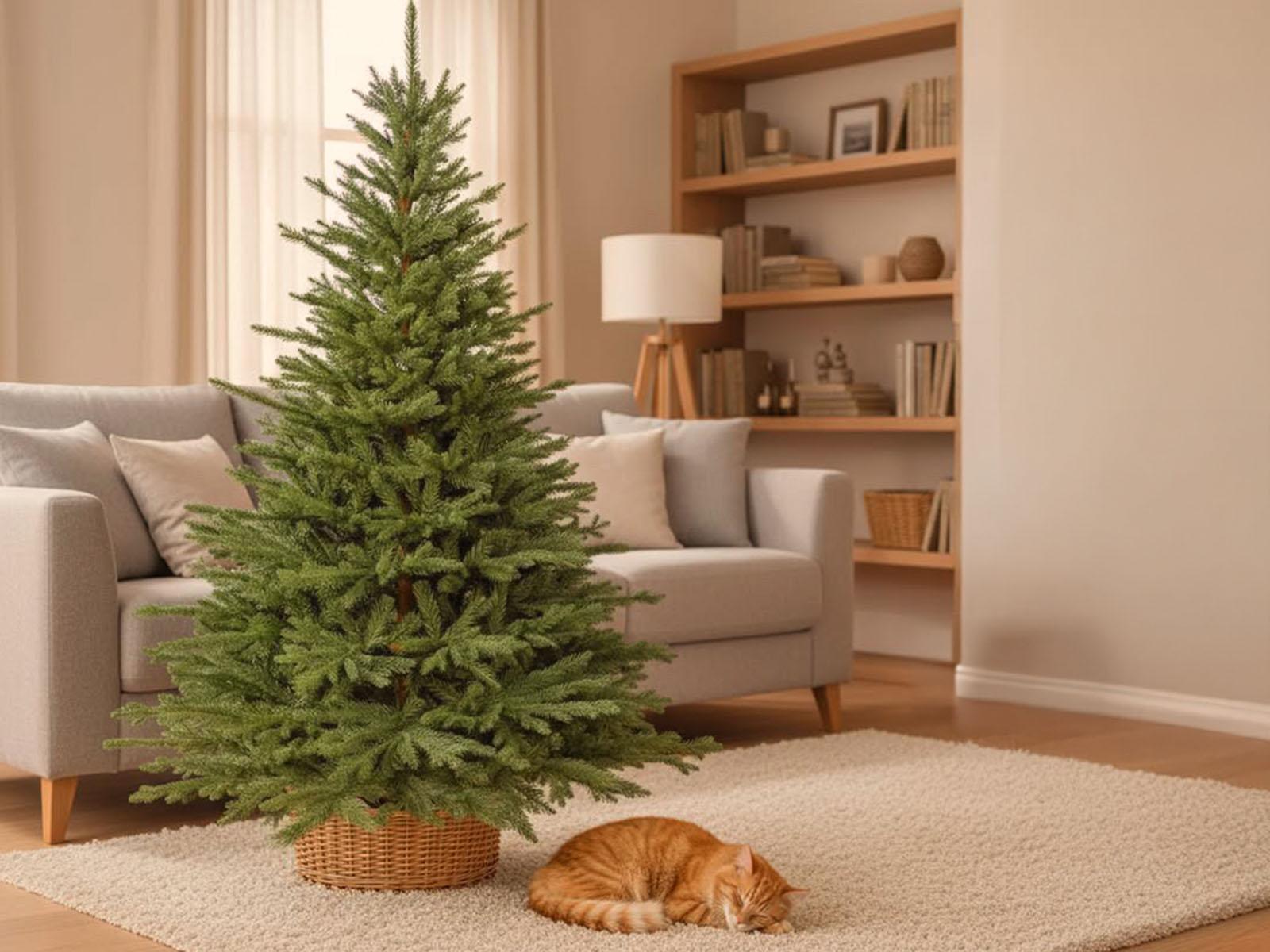
Christmas tree decorations and cats. What to look out for?
Sometimes it looks like this: half an hour spent hanging baubles, a few minutes of admiration, and then… one “snap” and all your work ends up on the floor. Cats love everything that shines and moves – which is exactly what we call Christmas decorations. But not everything that is pretty is safe.
-
Unbreakable Christmas tree decorations. The greatest risk to cats is posed by glass ornaments – sharp edges can cut their paws as they explore their surroundings, causing injury. Ornaments made of glass or other breakable materials should be avoided, as they can shatter and pose a serious hazard. Plastic Christmas tree decorations are less dangerous than those made of glass. Fabric or felt decorations can have soft shapes and friendly colors that fit perfectly into modern, Scandinavian, or rustic styles. Choose decorations made of fabric, wood, string, or paper that will not break if dropped and cannot be swallowed. Avoid very shiny ornaments, which may be particularly attractive to cats, and those that can easily fall off branches and pose a threat to your pet.
-
Tinsel and angel hair. Airy, shiny threads falling from branches may seem like a light addition to the decorations, but from a cat’s point of view, they are the perfect prey. They move with every breath of air, have a tempting shine, and can be tugged at with teeth or paws. String like materials such as tinsel and ribbons can cause serious illness if ingested, leading to life-threatening blockages. A cat can easily get tangled up in them, which can lead to problems with freeing itself or even suffocation. And swallowed tinsel can pose a huge threat to the animal’s health, causing injury or serious illness. Angel hair, if eaten by a cat, can lead to intestinal blockage and, in extreme cases, death.
-
Artificial snow and glitter. Most products of this type contain chemicals that are irritating and potentially toxic to cats. Even small amounts of fake snow or glitter can be dangerous to cats, risking poisoning – even if contact is unintentional, they can end up on your cat’s paws, fur, and tongue.
How to arrange and attach decorations to an artificial Christmas tree?
The arrangement of decorations can determine whether your cat will treat the Christmas tree as a climbing tree or as an uninteresting piece of furniture. The most important rule: the bottom of the Christmas tree should be reserved only for safe decorations or… have no decorations at all. Try to place decorations in hard-to-reach places, i.e., higher up on the tree, so that your pet has less chance of coming into contact with them and there is no problem with them being knocked down. It is the lowest parts of the tree that are most vulnerable to your cat’s paws and teeth. If something hangs low, it is fair game from your pet’s perspective. Providing engaging cat toys can also help distract your cat from the tree decorations and keep them entertained.
Also, consider how the tree looks from a cat’s perspective: what moves with every movement, what shines, what sparkles? Sometimes it is enough to slightly rearrange the decorations to make them less appealing to your pet. Heavier decorations should be moved closer to the trunk of the tree. This will limit their “swinging” and make them more difficult to knock down with a single movement. Light decorations made of fabric or felt can be hung a little lower. If the cat knocks them down, nothing bad will happen.
The second issue is how to hang decorations on the tree so that the decorated tree does not encourage the cat to play. Wide ribbons or, even better, plastic cable ties are safer. The latter allow you to securely attach the decoration to the branch without leaving any slack. Decorate the Christmas tree together with your cat, involving it in the festive ritual and ensuring that the decorating is safe.
Delicate metal hooks, for example, can be dangerous. They are easy to knock off, and if they fall on the floor, your cat may swallow them or cut itself on them. Unfortunately, many popular bauble sets still contain them, so it is worth replacing them with something more secure right away.
Additionally, you can hang small bells on the lower branches. Not as a decorative element, but rather as an “alarm.” When your cat knocks a branch or starts to remove a decoration, you will hear a soft sound and have time to react. It’s a little trick that can really make your life easier – especially in the evening when you don’t have eyes in the back of your head.
How to protect Christmas tree lights from cats?
Christmas tree lights create a unique atmosphere: soft light, twinkling reflections, a little magic in the middle of winter… Unfortunately, from a cat’s perspective, it’s an interactive installation for chewing, climbing, and pulling. That’s why Christmas lights need to be well hidden and secured. For the sake of your cat, your tree, and your home safety! Always keep electrical cords out of reach of cats to prevent chewing or accidental harm. When choosing Christmas tree lights, pay attention to their insulation and how difficult they are to chew, which will increase your pet’s safety. It is safest to use battery-powered lights and remove them at night or when you leave the house. Keep your cat safe by securing the lights properly and avoiding potential hazards. What else is worth paying attention to?
Hide the wires deep inside the artificial Christmas tree
Remember not to run the lights along the outer parts of the branches. Freely hanging cables are like strings from a toy fishing rod for a cat. Therefore, when planning the lighting, it is best to think about running the cable deep between the branches, close to the trunk.
Placing the cable right next to the trunk of the tree makes it less accessible for play and accidental catching with claws. Hide the lights and cables by wrapping them tightly around the branches or hiding them behind furniture – it is important that they do not move freely. Well-placed lights can look just as impressive and are much safer.
Cable covers and shields
The end of the cable leading to the socket is often the most vulnerable to attack. It often runs across the floor, between presents, making it easily accessible to a curious cat. That is why it is worth providing physical protection. Ready-made cable covers are available on the market: plastic tubes, flexible braids, and masking strips. You can also use cardboard tubes to cover exposed wires, especially around Christmas lights, as a simple and effective safety measure.
Their main purpose is not so much to protect the cable itself from damage, but to prevent the cat from coming into contact with it. You can cover cables with protective materials such as plastic or cardboard tubes to keep cats safe and avoid accidental harm. Chewing on cables can lead to electric shock, burns in the mouth, and even more serious accidents.
What can you do to prevent your cat from attacking the Christmas tree?
If you want to protect your Christmas tree from your cat’s antics, it’s worth preparing for your pet’s various ideas. No tree is a completely cat safe Christmas tree, whether real or artificial, but taking the right precautions can minimize risks and help keep your feline friend safe during the holidays. Some cats treat Christmas trees as an extreme sport. Many cat owners have already had to deal with their cats attacking the Christmas tree – you’re not alone! In such cases, the best strategy is simply a physical barrier. Some methods may prove effective, especially if your cat is an exceptionally creative Christmas helper. The idea is to create a boundary that your cat won’t cross out of curiosity… or won’t cross too easily. These strategies help keep your feline friends safe and happy throughout the festive season.
What smell deters cats the most?
The most commonly used home remedy is citrus, which most cats sincerely dislike. Simply place a few orange or tangerine peels at the base of the tree, or soak a cotton ball in lemon oil. This is a simple and safe way to discourage your pet from getting closer.
Apple cider vinegar works in a similar way. Its intense, pungent smell effectively repels many cats. You can spray it on a few pine cones and place them under the tree, or add it to water in a spray bottle and gently spray it around the base. However, it is important not to overdo it. The idea is to create a subtle scent.
It is crucial to use only substances that are safe for animals. Some deterrent substances can be toxic to cats and should be avoided. Some essential oils (e.g., tea tree, clove, or peppermint) can be toxic to cats, even through skin contact. Therefore, if in doubt, stick to proven and mild solutions.
Physical fence around an artificial Christmas tree
Sometimes a mini fence is the best solution. Decorative fences, children’s playpens, or low barriers can effectively restrict your cat’s access to the Christmas tree without spoiling the atmosphere. These barriers also help keep your kitty safe from holiday hazards like climbing the tree or chewing on decorations. And for guests, they can look like part of the decor. Who said that safety measures can’t be stylish?
It is important that the fence is high or stable enough so that the cat cannot simply push it over with its paw. If your pet tends to jump over obstacles, you can try combining the barrier with deterrent smells.
Another good trick is to use a cat tunnel, i.e., a round tunnel made of soft material, which you spread around the base of the Christmas tree. It works in two ways: on the one hand, it creates a physical barrier (the cat has to go around or jump over it), and on the other hand, it gives the cat space to play next to the tree, but not on it. Such a tunnel can distract your pet and make it feel cared for, not rejected.
Remove food-scented gifts from under the tree
Sometimes it’s not the tree itself that attracts the cat, but what’s under it. If you start wrapping gifts in advance (and among them are treats, catnip toys, or anything else that smells good), you may unknowingly create a zone of temptation for your cat under the tree. Food gifts covered in tasty coatings can be especially tempting for cats, making them more likely to lick or chew on the packages.
It’s best to keep scented gifts away from the tree until Christmas Eve. You can store them in a cupboard, on a high shelf, or in a closed box. Only place them under the tree just before handing out the gifts. Then there is less risk that the cat will spot them and treat them as its prey. After all, who among us doesn’t like unwrapping Christmas presents… but it’s better if it’s done by a human, not a purring saboteur.
Also, keep in mind that some packaging materials, such as rustling foil, shiny ribbons, or glittery paper, can further attract your cat’s attention. If you have to keep gifts under the tree early, choose neutral packaging without any scent or excessive glitter. This will reduce the risk of them becoming the target of the first Christmas attack. Remember, even small quantities of certain foods can be dangerous for cats, so it’s important to keep all edible gifts safely out of reach.
How to teach your cat that the artificial Christmas tree is off limits?
Not all obstacles can be physically placed. And while mechanical or scent-based safeguards are helpful, consistent training and communication are often the most effective. Contrary to appearances, cats are not malicious when they knock over a Christmas tree. They are simply testing boundaries. And these boundaries must be set clearly, calmly, and firmly. If you suspect that your cat has eaten something dangerous while playing with the Christmas tree, do not delay in responding.
Just because a cat doesn't “understand” something the first time doesn't mean it will never understand. On the contrary, cats learn very well through repetition. That's why it's crucial to always react the same way. Instead of yelling (which may only scare the cat), use a short, clear message, clap your hands, or snap your fingers. It is important that your tone of voice is firm but not aggressive. If your cat has any health problems, always consult your veterinarian.
It is also important to reward good behavior. When your cat plays with a scratching post instead of a Christmas tree, praise it, pet it, and give it a treat. Positive reinforcement works better than prohibitions because the cat begins to associate that cool things (treats) happen away from that big, prickly object (the Christmas tree).
What if the cat approaches again? Don't ignore this signal! The cat is trying to get your attention. When this happens, you need to find a good alternative to keep the cat from getting bored.
What can you do to keep your cat from climbing the Christmas tree? Attractive cat alternatives
You can’t win with a cat by force. The cat may approach the Christmas tree, try to climb it, or get close to the decorations, which can lead to the tree falling over or the decorations being damaged. You can set up obstacles, anchor the Christmas tree, hang decorations, but if you don’t give it something in return, it will come back anyway. For cats, the holidays mean more people, more stimuli, new things, and new smells – including the scents of other animals that may visit your home. The holiday season can be a stressful time for cats due to these changes, as well as the presence of unfamiliar guests and increased activity. Additionally, toxic plants commonly used as Christmas decorations are another hazard to watch out for during the holidays. And in all this, cats also need space for themselves, their own fun, and a little attention. So instead of fighting, it’s better to cleverly redirect their interest.
Your cat’s own “tree”: a scratching post or a mini Christmas tree
Cats need space to climb and explore. When a large, green “plant” full of shiny objects suddenly appears in the living room, it's no surprise that they treat it as new territory. If you don't want the Christmas tree to become a cat clawing target, give your cat its own tree that will be just as attractive but safe.
It's a good idea to place a classic scratching post or cat shelf nearby – but not directly next to the Christmas tree, so that they don't become a trampoline. You can decorate such a scratching post in a festive style: add bows, safe plush toys, and even a small felt “mini Christmas tree” for your cat. Use catnip or valerian to further attract their attention to this place.
The most important thing is for your cat to have its own space to play and explore, which it will accept as an alternative. It doesn't have to be anything fancy, as long as it has a place to jump, hide, and play. And if they get a reward for it (e.g., a treat or your attention), they will quickly learn that this is their “Christmas” place, and the tree can be left alone.
Distract your cat with regular play
Cats are masters of observation, but they also get bored quickly. When they don't have enough stimuli during the day, they create their own. And since the Christmas tree is a whole series of visual and auditory attractions, it quickly becomes their number one target.
Therefore, one of the most effective ways to limit cat mischief around the tree is daily, active play. Spend at least a dozen minutes a day playing intensively with your cat: preferably before bedtime or before leaving the house. Feather fishing rods, balls, mice, interactive toys... Anything that allows them to release their energy and satisfy their hunting instinct will work. A tired cat is a happy cat. And more importantly, it's a cat that isn't looking for trouble.
It's a good idea to place toys away from the Christmas tree to direct your cat's attention in a completely different direction. You can also change them every few days or hide them for a while, then bring them back as a “new” attraction. Even simple play with a cardboard box or paper bag can work better than a whole set of baubles, as long as your cat has the opportunity to let off steam.
Providing your cat with peace and refuge during the holiday season
Although Christmas is associated with warmth and joy, for many cats it is a time of anxiety. New smells, more guests, changes in the daily routine – all of this can be exhausting for your pet. Cats are particularly sensitive to stress associated with new situations, such as changes in their environment during the holidays.
Creating a safe haven for your cat is a great idea for a peaceful Christmas. This could be a room that guests are not allowed to enter. Or a high bed in the corner of the room from which your cat can observe everything from a distance. It's good if this place has your cat's favorite things, such as a blanket or pillow.
When your cat feels calm and has its own space, it is much less likely to resort to desperate measures such as attacking the Christmas tree. And you can breathe a sigh of relief and focus on what really matters during the holidays.