
Christmas Tree in Space. How Do NASA Astronauts Decorate a Christmas Tree in Earth Orbit?
A few festive trinkets, a small tree attached to the interior, a stocking hanging by the table, flashlights pretending to be candles, and a view of Earth through the window. This is what Christmas looks like where there is no floor, no classic living room, and no space for elaborate decorations. And yet, it’s surprisingly easy to recognize something very familiar in these scenes. Astronauts on the International Space Station (ISS) celebrate Christmas by hanging stockings and opening gifts sent from Earth, which fosters a sense of community and unity. On several occasions, astronauts have celebrated Christmas in space, making it a cherished tradition during the holiday season and festive season. There is a shared meal, a touch of humor, a homely gesture, and the need to feel the rhythm of December, if only for a moment.
- A space Christmas tree rarely resembles a classic tree from home. In orbit, you’re more likely to see a miniature decoration, a fabric banner, an embroidered appliqué, or an ingenious structure made from items already on board. Decorating the Christmas tree together and watching sunrises from orbit builds a sense of unity among the crew, and the holidays are traditionally a time for friends to gather, even in space.
- Christmas decorations on the space station must adhere to very specific rules. What matters is mass, volume, flammability of materials, outgassing, ease of storage, and the absence of particles that could float around inside.
- Holidays in space are of immense importance to the crew’s morale. A shared meal, a small Christmas tree, and a few symbolic decorations help ease the isolation and remind them of home. Among the traditions are also preparing milk and cookies for Santa’s arrival and opening gifts hidden in Christmas stockings—these are annual traditions on the ISS. The need for a sense of December’s rhythm means that, thanks to these rituals, astronauts gain a sense of closeness to their families and Earth.
The most touching thing about holidays in orbit is how little it takes. Sometimes a small Christmas tree by the table is enough, sometimes a banner pinned to the wall, sometimes a joke tossed to mission control. The rest is left to the imagination.
That is precisely why the history of space holidays is so captivating. It combines technology and tenderness, procedures and family associations. It also shows that even hundreds of kilometers above Earth, people still seek out the December symbols they know from home.
Table of Contents:
-
The first Christmas tree in orbit? Skylab 4 did it their own way
-
Holidays on the International Space Station. Small decorations, a multinational crew
-
Why does a space Christmas tree have to be light, small, and safe?
From Apollo 8 to the ISS. How Christmas in space came to be
The beginning of Christmas traditions in space can be traced to the Apollo 8 mission, marking a new chapter in how astronauts celebrate the holidays away from Earth. The Christmas tradition in orbit didn’t immediately take the form of a Christmas tree and decorations. First came the symbolism.
The first crew to spend Christmas in space was the Apollo 8 mission, which launched on December 21, 1968. It was then that the world witnessed one of the most memorable Christmas scenes in the history of spaceflight. The astronauts broadcast a transmission in which they read a passage from the biblical Book of Genesis during Christmas Eve, watched by a billion people in 64 countries around the world. Millions of people listened to the voices coming from outer space on Christmas Eve. This music broadcast and reading from the Book of Genesis by Frank Borman, Jim Lovell, and Bill Anders became a defining moment in space history. As a fact, this event stands as one of the most significant milestones in the tradition of celebrating Christmas in space.
A day later, on December 25, 1968, a much lighter but equally memorable moment occurred. After the return maneuver, as the astronauts were leaving lunar orbit, Jim Lovell reported to mission control:
„Roger, please be informed there is a Santa Claus”
One sentence, a brief joke, yet it has become a permanent part of history.
Among the stories of early space holiday events, another milestone was the first piece of music played in space: during the Gemini 6A mission in 1965, astronauts Wally Schirra and Thomas Stafford surprised mission control with a 'Jingle Bells' music broadcast, using a harmonica and bells. This playful act marked the first time a holiday song was played in space, setting the stage for future celebrations.
Ever since Frank Borman, James Lovell, and William Anders became the first in history to leave Earth’s orbit, holidays in space have become a tradition. Even during missions of immense importance, the astronauts sought out moments that felt familiar and human:
-
In 1973, the Skylab 4 crew spent Thanksgiving, Christmas, and New Year’s in space.
-
In 1993, during STS-61, a Hanukkah celebration in space was documented (due to fire restrictions, the menorah was not lit).
-
In 1999, the crew of STS-103 were the first to celebrate the holidays aboard the space shuttle Discovery.
Since then, American crews on NASA missions have regularly celebrated the holidays in orbit, and with the start of a permanent human presence on the ISS, holiday greetings and shared December meals have become an annual tradition.
The first Christmas tree in orbit? Skylab 4 did it their own way
To trace the origins of the space Christmas tree, we must go back to December 24, 1973. Astronaut Edward Gibson, as part of the Skylab 4 crew, played a key role in creating the first Christmas tree in space. The astronauts on the Skylab 4 mission had neither a ready-made tree nor a box of decorations at their disposal. So they did something much more interesting: after eating, the crew built a Christmas tree using leftover food containers and other available materials. This marked the first Christmas decorations in space, as the Skylab 4 crew commemorated the holiday by making a tree out of food containers. The improvised space Christmas tree was decorated with a cardboard comet by Kohoutek - an important motif of this mission - and colorful stickers.
The crew also commemorated Christmas by establishing a tradition of communicating with their families via satellite link, making the occasion even more special.
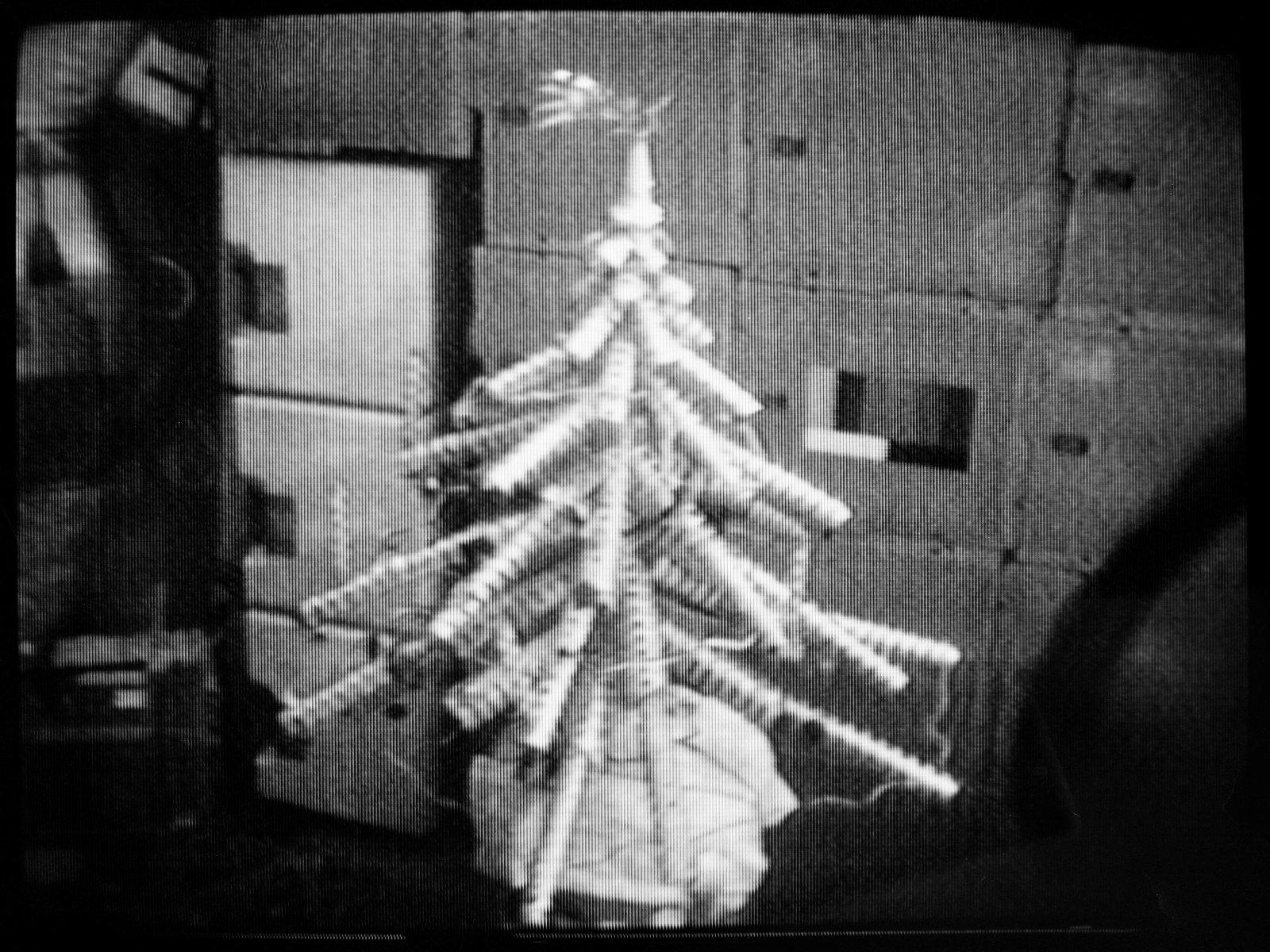
The Christmas “tree” created by the Skylab 4 crew in orbit, December 24, 1973. Source: NASA (Public Domain), via Wikimedia Commons.
This story perfectly illustrates how orbital imagination works. Instead of a traditional tree, a Christmas tree was created from items already on board - mainly scraps and leftover containers. No extra cargo, no taking up valuable space, no complicating logistics. A bit like a homemade decoration made with the kids from whatever’s lying around, only a few hundred kilometers above Earth.
What does a Christmas tree look like in zero gravity?
In orbit, a Christmas tree almost never stands proudly in the middle of the room. More often, it’s attached to the interior, placed by the table, hung as a banner, or reduced to a symbolic motif. These unique traditions of celebrating Christmas in zero gravity are often commemorated with a photograph, capturing the creative ways astronauts bring holiday spirit to space. In practice, four solutions are most common.
Mini Christmas tree by the table
In a photo from December 28, 2005, taken in the Zvezda service module on the ISS, two crew members can be seen wearing Santa hats. They are holding Christmas stockings, and on the table stands a small Christmas tree and a figurine of Santa Claus. The scene looks surprisingly familiar. The difference is that everything must be carefully arranged and secured, because in zero gravity, nothing stays where it was placed. Astronauts often enjoy special meals during Christmas celebrations, making the occasion feel more festive and homelike.
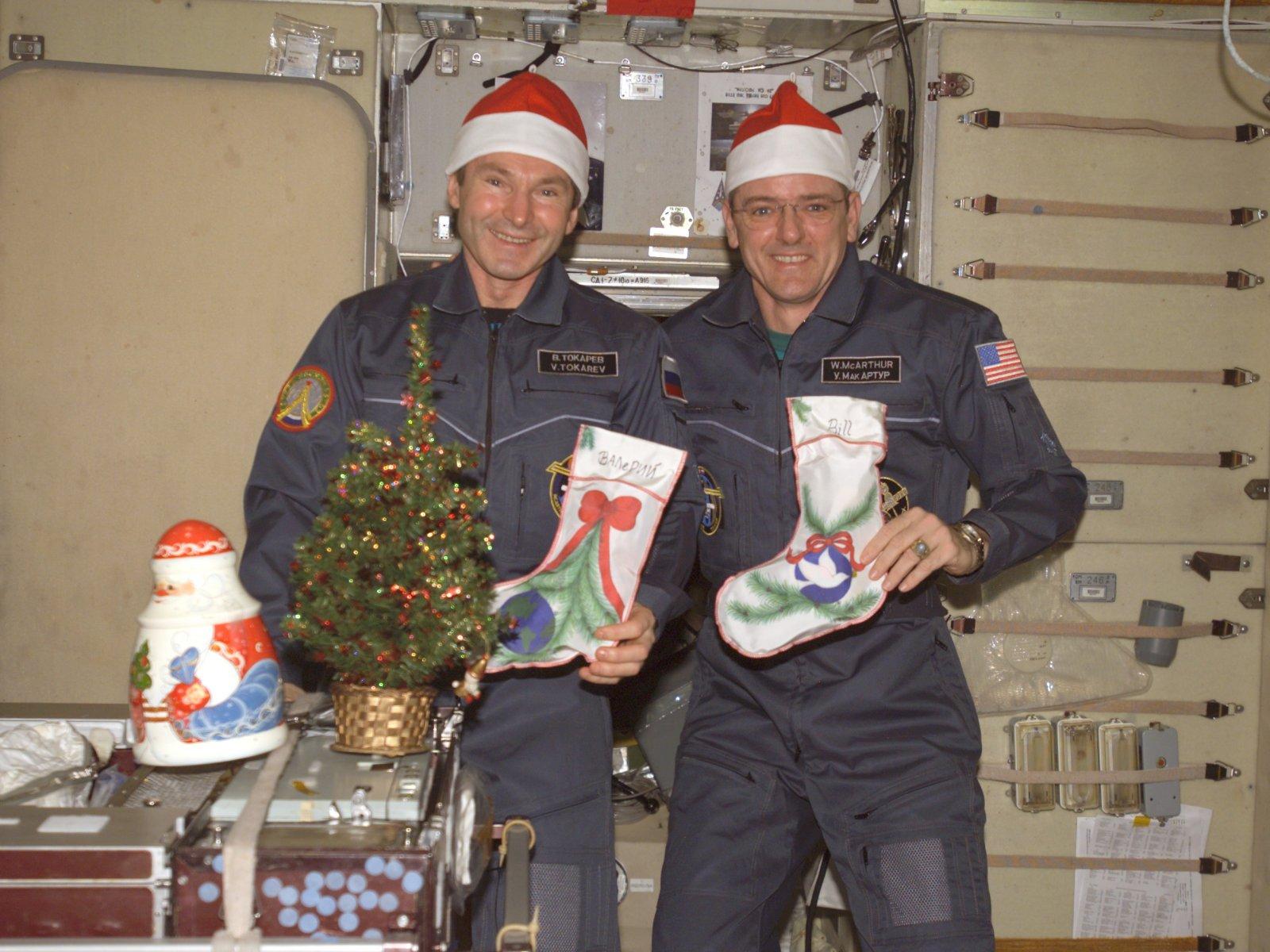
Astronaut William S. McArthur Jr. and cosmonaut Valery I. Tokarev pose for a Christmas photo aboard the International Space Station, December 2005. Source: NASA (Public Domain), via Wikimedia Commons.
A Christmas tree in the most beautiful window to Earth
On December 25, 2015, the Expedition 46 crew decorated the Cupola, a module with panoramic windows. A small Christmas tree appeared there, attached to the interior. It’s hard to imagine a more symbolic place. On one side, a festive symbol; on the other, Earth as seen from orbit. Photos like these need no words.
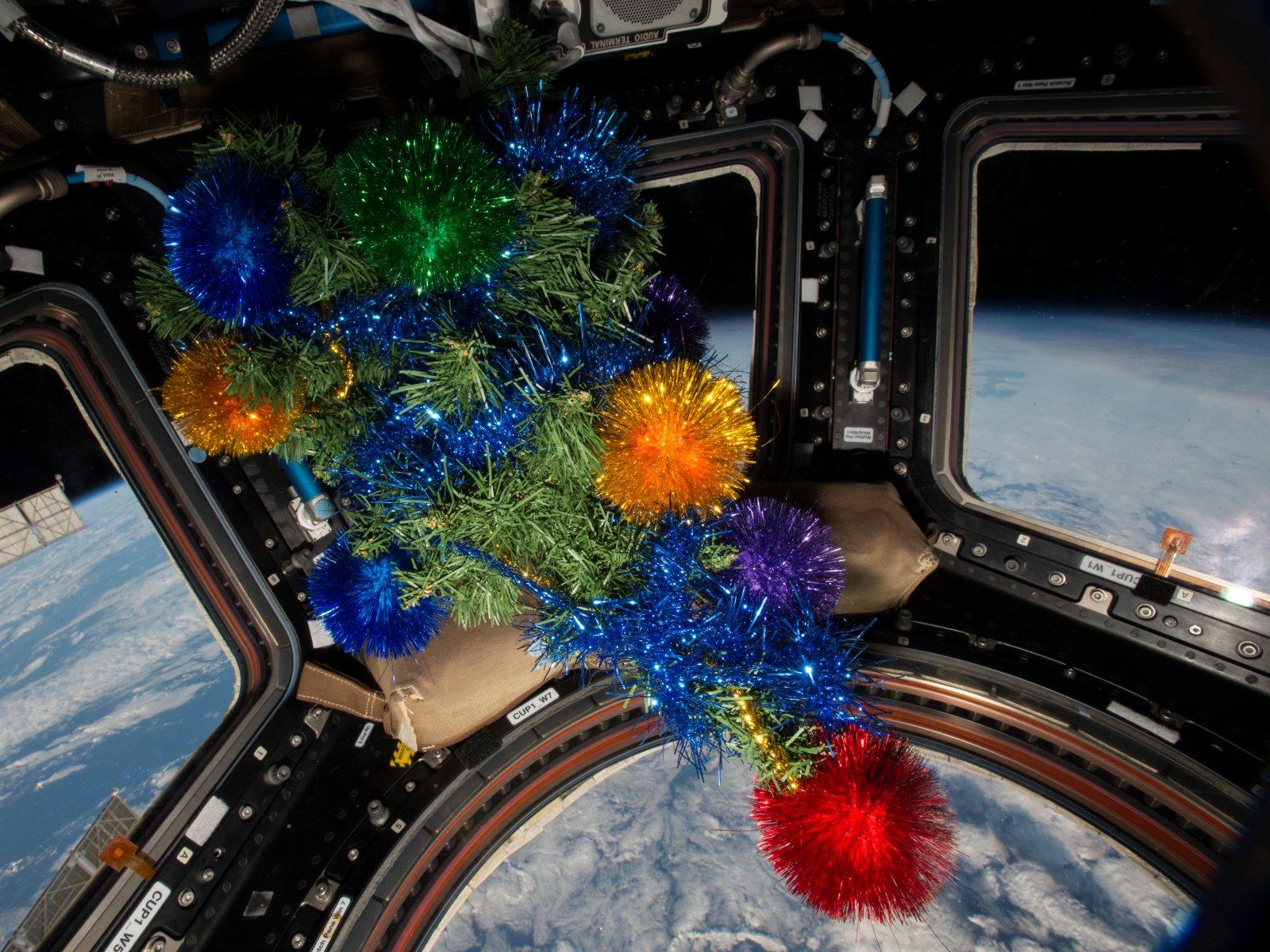
A decorated Christmas tree in the Cupola module on the International Space Station, December 25, 2015. Source: NASA (Public Domain), via Wikimedia Commons.
A Christmas tree as a banner
On the ISS, decorations don’t have to be three-dimensional. During the 2019 holidays, the Unity module featured stockings, “candles” made from flashlights, and a Christmas tree-shaped banner. This is a very practical solution. A flat decoration is easy to transport, easy to store, and there’s no risk of small pieces scattering around the cabin.
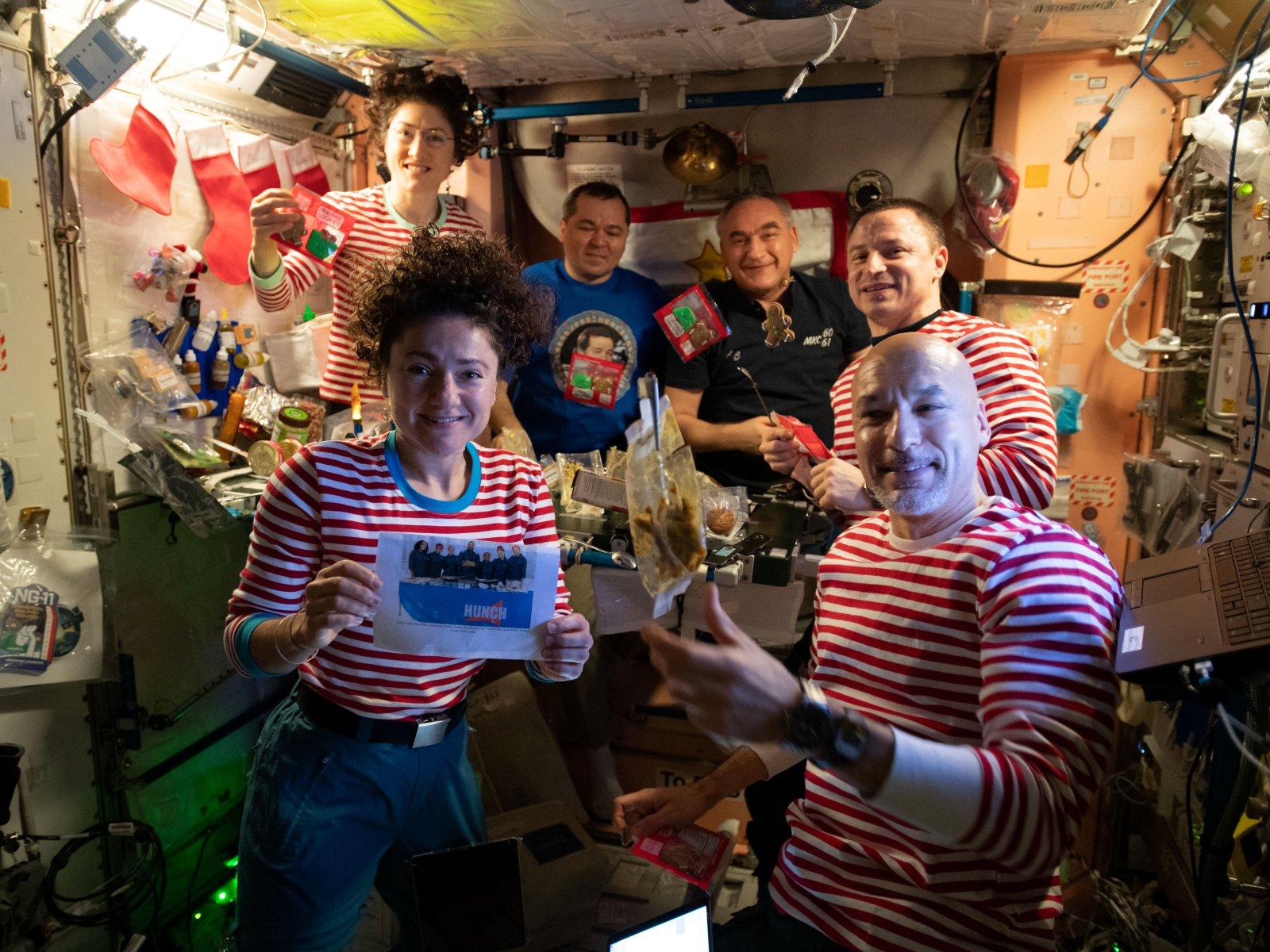
Expedition 61 crew’s Christmas brunch on the International Space Station, December 2019. Source: NASA (Public Domain).
The Christmas tree as part of the communal table
Photos and reports from subsequent years show that decorations most often center around a shared meal. This was also the case on December 25, 2023, when NASA showcased the Christmas meal of the international crew, comprising NASA, ESA, and JAXA astronauts. Typically, three astronauts or more celebrate Christmas together in space, gathering for a festive meal and decorating their living area. Gift exchanges are an important part of the celebration, with astronauts planning their gifts well in advance to keep them a surprise for Christmas. The small decoration then serves as the focal point of the entire scene.
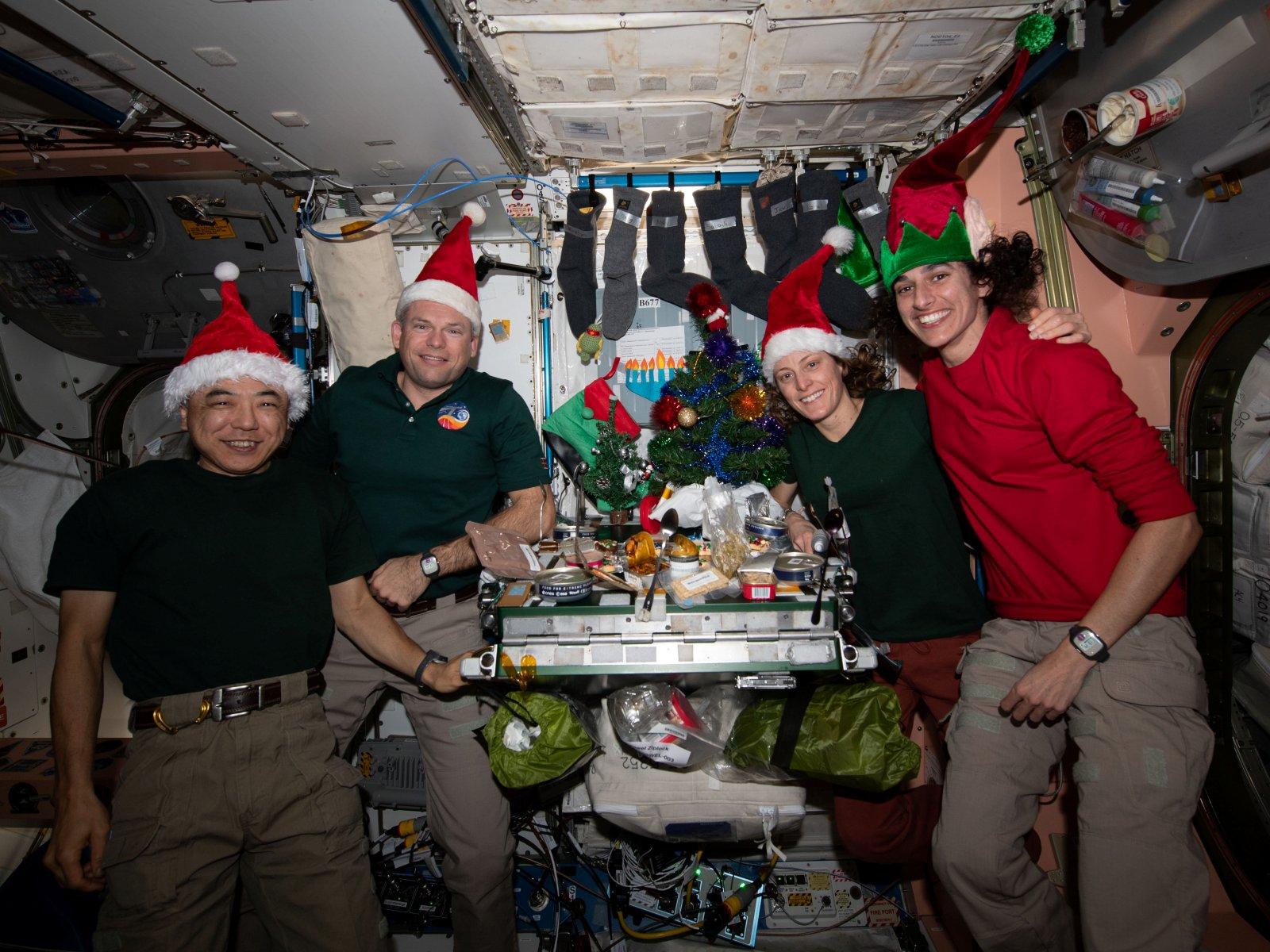
The Expedition 70 crew celebrates Christmas together aboard the International Space Station, December 25, 2023. Source: NASA Johnson Space Center (Public Domain), via Wikimedia Commons.
Holidays on the International Space Station. Small decorations, a multinational crew
The ISS has given space holidays a new rhythm. Previously, there were isolated moments; today, we have an annual tradition. Since Expedition 1, or since 2000, December on the station has regularly brought greetings, group photos, and a holiday meal.
This year’s Christmas on the ISS was celebrated by astronauts from NASA and the European Space Agency, including a British astronaut, as well as cosmonauts from Russia, sharing traditions from various countries and cultures. Astronauts celebrate Christmas and others holidays from different countries, reflecting the diversity of traditions and faiths aboard the ISS, and showing that the holiday spirit is shared by people of all faiths or none. Astronauts and cosmonauts hold conversations and send messages to families and people around the world, highlighting the global dimension of the holidays. They often communicate with their families via satellite and participate in video calls to share holiday wishes and support each other during these occasions. NASA astronaut Thomas Marshburn emphasized in his statement that “during this special time, all people around the world can feel a sense of unity and community, no matter where they are.” Families, people, and a sense of community play a key role in the holiday celebrations on the ISS, reminding the crew of the bonds that connect them to Earth. The support from mission control and ground teams is especially important during these festive occasions.
It is particularly interesting that different cultures and calendars come together on the ISS. In the Western tradition, December 25 is significant. In the Russian segment, New Year’s is also very prominent. In practice, these traditions blend beautifully on the station. The crew may celebrate Christmas on both December 25 and January 7, following the course of different cultural calendars, and may celebrate Christmas multiple times due to the presence of different cultural traditions. Alongside Christmas accents, New Year’s decorations appear, and the “Christmas tree” serves more broadly as a winter holiday symbol. Astronauts often share traditional foods from their home countries during these occasions, making the celebrations even more meaningful.
Humor also makes a regular appearance. In NASA and Roscosmos materials, Santa hats, stockings, light-hearted jokes, and a playful tone are recurring themes. In such a demanding environment, this is of great importance. A few props and a group photo help lighten the mood for a moment.
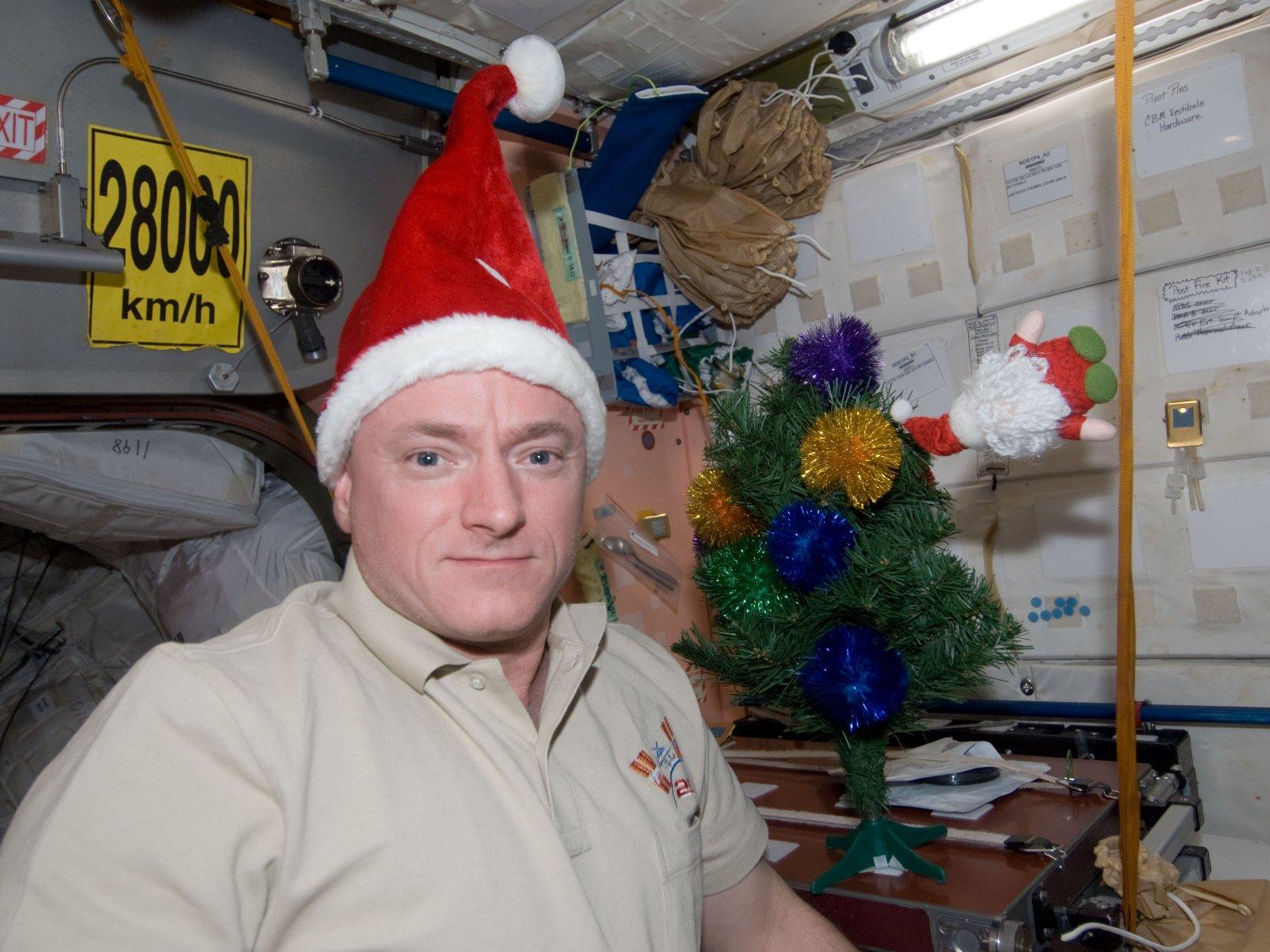
Astronaut Scott Kelly wearing a holiday hat aboard the International Space Station, December 2010. Source: NASA (Public Domain), via Wikimedia Commons.
Why does a space Christmas tree have to be light, small, and safe?
At home, we usually think about the tree’s height and the style of the decorations. On the space station, the first questions are different. How much does an item weigh? How much space does it take up? What is it made of? Can it be safely transported and stored?
This is clearly illustrated by the limit on personal items for an astronaut flying to the ISS. The Personal Preference Kit measures just 5 × 8 × 2 inches, or about 12.7 × 20.3 × 5.1 cm. That’s all the space left for mementos, small gifts, and personal symbols. Over time, Christmas traditions in space have developed to adapt to these strict limitations, with astronauts and mission planners finding creative ways to celebrate. It’s hard to fit elaborate decorations into such a package. However, a small ornament, a foldable banner, a fabric appliqué, or a small festive detail fits in without a problem.
Added to this is the requirement to declare the contents in advance. Such an item doesn’t go into orbit spontaneously. It must be on the list and go through the appropriate approval process. In addition to personal kits, supply missions are sometimes timed to bring holiday gifts and surprises from Earth - like in 2010, when astronauts' relatives arranged for surprise Christmas stockings to be sent to the ISS. Therefore, the most practical decorations are those that are lightweight, small, reusable, and easy to pack. The second important consideration is the preparation phase - selecting decorations that can be easily installed and just as easily removed after the holidays.
That is precisely why mini-Christmas trees, banners, embroidered ornaments, and ideas utilizing elements already present on the station work so well. Skylab 4 did this intuitively as early as 1973.
What does the holiday ritual offer astronauts?
In the December photos from orbit, the scale of these gestures is most endearing. A few stockings. Santa hats. A small Christmas tree. A holiday table. Flashlights pretending to be candles. That’s enough to make the station’s interior feel a bit cozier for a moment.
During the space holidays on the International Space Station (ISS), the astronauts feasted on a special Christmas Eve dinner menu: smoked turkey, sweet potatoes, green beans, and freeze-dried corn sauce. Other dishes included salted pork with lentils, stew, pork dishes, potatoes, and Mexican tortillas. Astronauts typically spend Christmas eating a special meal together, listening to Christmas music, and watching films. In December 2019, the first food baked in space was chocolate chip cookies, marking a unique holiday experiment. Astronauts often take a break from their duties to celebrate, but sometimes must return to work for critical tasks even during the festive week. They use their free time to connect with loved ones, wish each other and their families a happy Christmas, and share stories they have heard about celebrating the season in space. The harmonica has even been played during Christmas celebrations, adding to the festive atmosphere. Astronaut Andrew Morgan has shared his experiences of Christmas and New Year aboard the ISS, highlighting international cooperation and the blending of traditions. Clear communication and heartfelt messages are exchanged between astronauts and mission control during the holidays. Sometimes, astronauts have claimed to see interesting phenomena, such as unidentified objects orbiting the Earth. The fate of holiday traditions in space reflects the broader human desire for connection, regardless of distance. Launches are sometimes timed to coincide with the holiday season, making celebrations even more special.
There was no shortage of New Year’s celebrations either—astronauts raised toasts in glasses, sometimes with alcohol, celebrating the arrival of the new year in orbit. Because the Earth orbits the Sun quite quickly, they can celebrate New Year’s even several times a day.
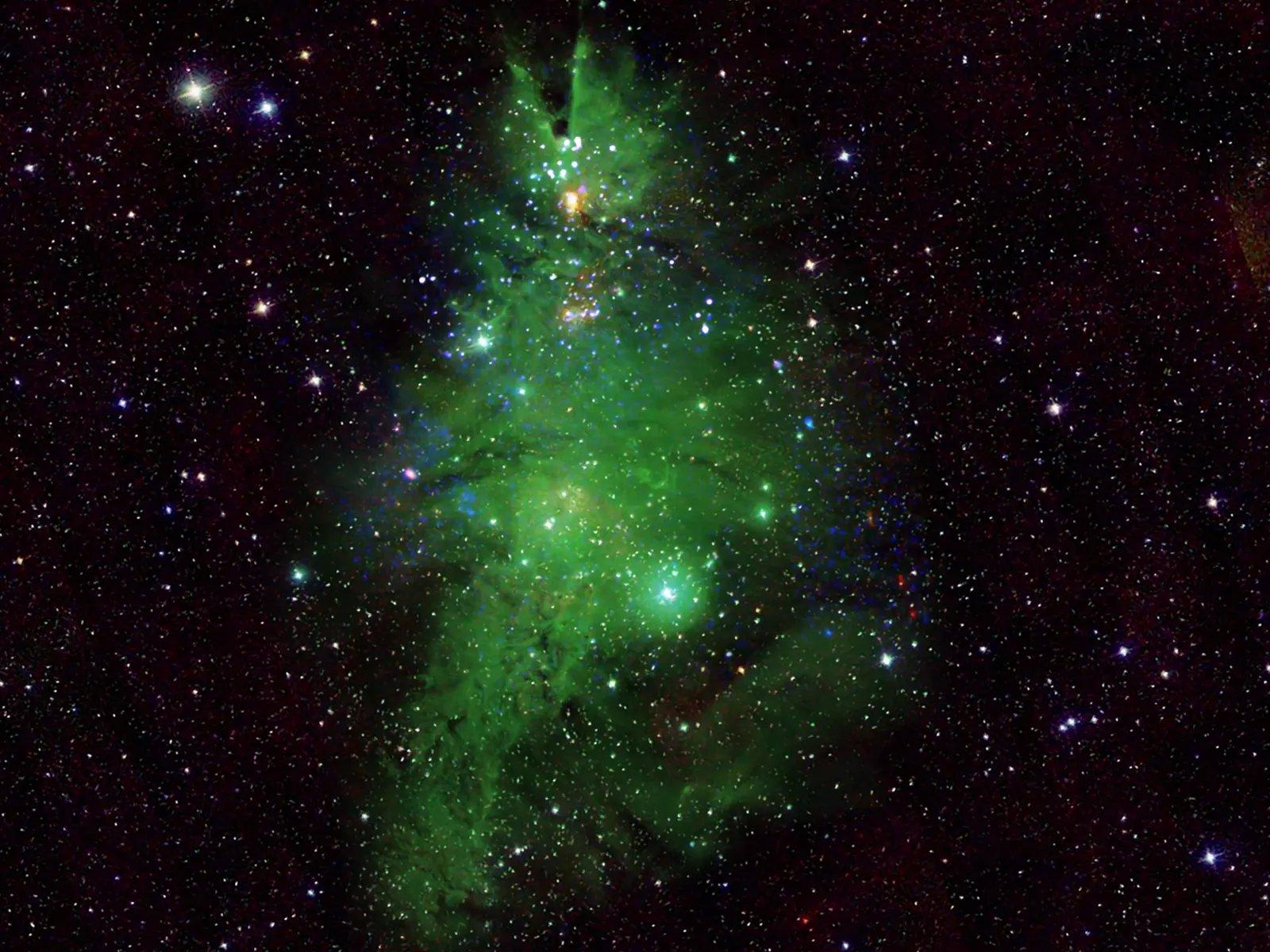
For astronauts, such a ritual is of immense value. Missions mean separation from loved ones, a confined space, a tight schedule, and a heavy burden of responsibility. A shared meal, decorations pinned to the wall, and a familiar symbol help them catch their breath. They bring a sense of familiarity to everyday life. During this time, astronauts send radio messages to their loved ones and to Earth, and also write poems with holiday greetings, as William Shepherd did in the ISS logbook. The season is celebrated in space by accommodating different traditions and calendars, and the crew often listens to Christmas music, watches holiday movies, and decorates with stars and other celestial symbols. The stars themselves, such as those in the NGC 2264 cluster, inspire the Christmas tree theme and remind astronauts of the wonders beyond their window.
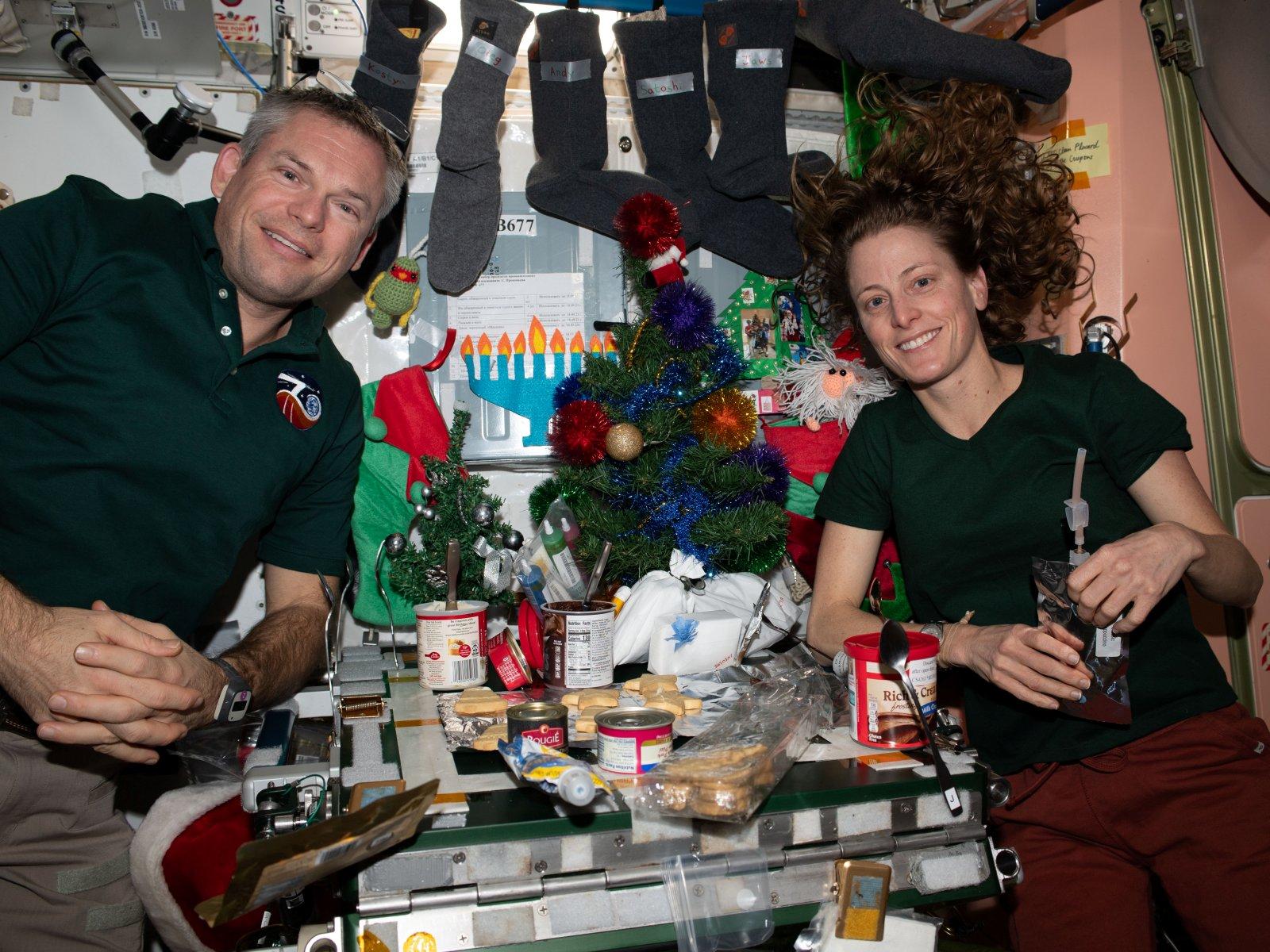
Andreas Mogensen and Loral O’Hara during a holiday meal aboard the International Space Station, December 2023. Source: NASA Johnson Space Center (Public Domain), via Wikimedia Commons.
Perhaps that is why space holidays stay in our memory? They appeal through their simplicity. Everything fits into a few images, and each one reminds us that even in orbit, people still want to celebrate the holidays in their own way.
Main image: The NGC 2264 cluster, known as the “Christmas Tree Cluster,” photographed by telescopes collaborating with NASA. Source: X-ray: NASA/CXC/SAO; Optical: T.A. Rector (NRAO/AUI/NSF and NOIRLab/NSF/AURA) and B.A. Wolpa (NOIRLab/NSF/AURA); Infrared: NASA/NSF/IPAC/CalTech/Univ. of Massachusetts; Image Processing: NASA/CXC/SAO/L. Frattare & J. Major (Public Domain).