
A safe Christmas tree and baby. How to prepare your home for your little one's first Christmas?
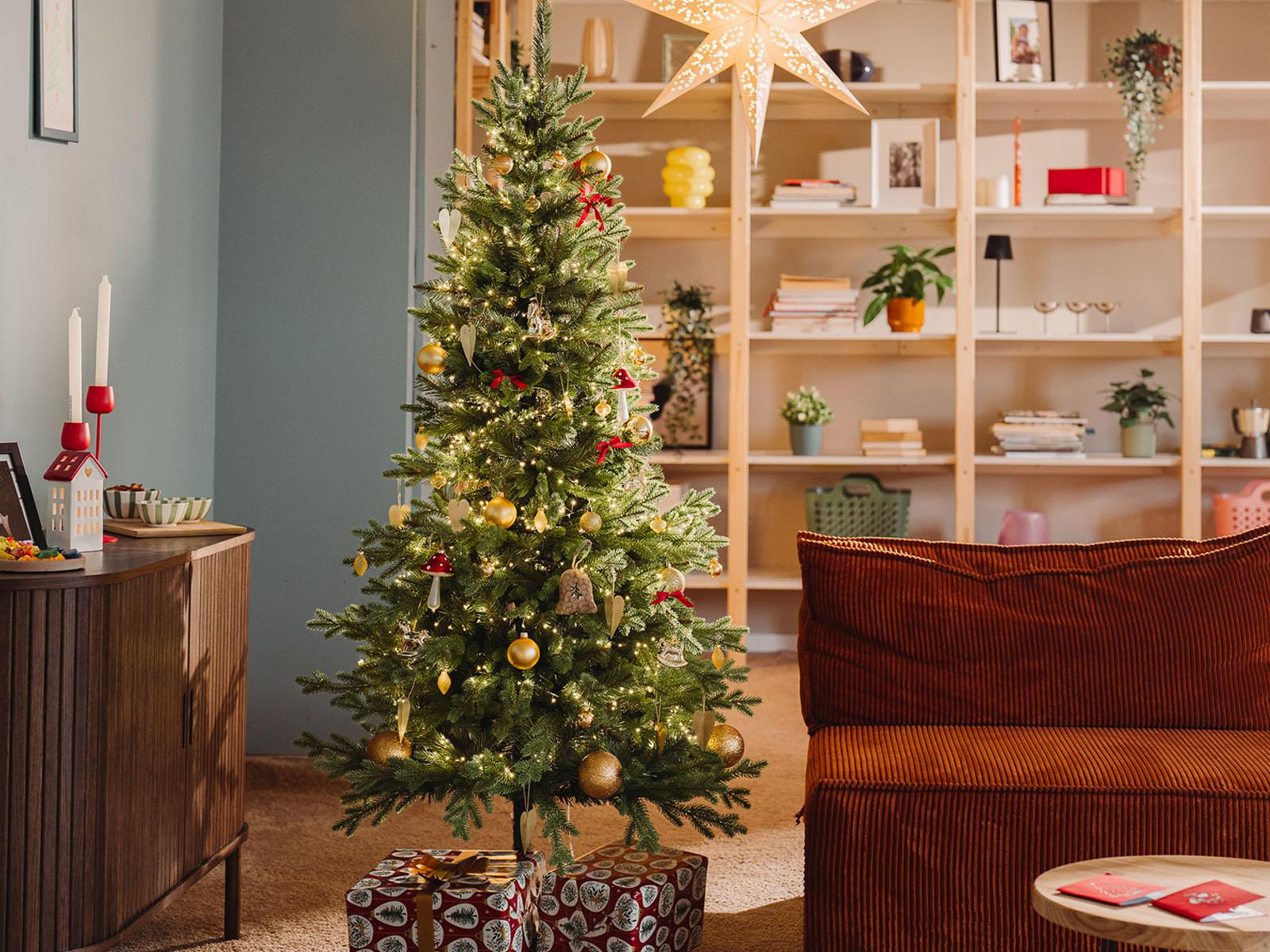
The first Christmas with a baby is more meaningful than any gift – and at the same time puts parents on high alert. After all, a twinkling Christmas tree instantly grabs a toddler’s attention. In this guide, you will find practical tips to make your Christmas tree a safe decoration for your little explorer.
-
Choose a stable, high-quality tree - for example, those from FairyTrees. Weigh down the stand of your artificial Christmas tree and additionally anchor it to the wall or furniture so that even a strong pull on a branch will not cause the tree to fall.
- Limit your toddler's access to the Christmas tree. Place the tree in a corner or on a raised platform, use a barrier made of heavy gift boxes, or a separate, small Christmas tree for your child so that your curious toddler does not have free access to branches, cables, and decorations.
- Choose safe decorations and lighting. Opt for unbreakable decorations without small parts, hang the most delicate baubles high up, choose LED lights, hide cables out of reach, and always turn off the Christmas tree lights when no one is supervising the child in the room.
The glow of the lights, the soft swish of the branches, and the colorful baubles create an image that adults have known for years, but which a toddler is seeing for the first time. For many families, this is the season when they ask themselves, “How can we set up the Christmas tree with a baby around so that the holidays go smoothly, without constantly running after a curious crawler?”.
More and more parents are choosing artificial Christmas trees because they are easier to control, do not shed sharp needles, and can be prepared in advance without having to clean dry needles off the floor. However, just picking the tree is not enough when you have a child who has just discovered that the world can be explored with their hands, mouth, and by climbing on everything within reach.
Therefore, instead of giving up on the Christmas tree, it is worth introducing a few simple rules. A well-chosen artificial Christmas tree, a stable stand, a well-thought-out location, safe decorations, and wisely routed cables will transform your living room into a space where the magic of Christmas meets concern for the safety of the youngest member of the household.
Table of contents:
- Where to put the Christmas tree with a toddler?
- Try clever solutions: a barrier, a “fort” made of presents, a children's Christmas tree
- Child-safe Christmas decorations
- Which Christmas tree decorations are best avoided with a child?
- Safe lights and cables out of reach of little hands
- Tidiness around the tree – small details make a difference
- Adult supervision is the most important “safety measure”

Start by choosing a safe artificial Christmas tree
Child safety starts with the tree you buy. Christmas trees that shed far less than real ones and don’t have factory-attached components that can come loose work best with small children. The fewer loose bits on the floor, the lower the risk of choking.
Choose quality and a proven manufacturer - such as FairyTrees. A good-quality artificial tree that meets safety standards creates a safer starting point. The rest depends on how you set it up and decorate it.
Make sure you have a stable stand and a solid base
With a child who is crawling, climbing on furniture, and grabbing everything within reach, the stability of the Christmas tree takes on a whole new meaning. The base should be able to support the weight of the tree and keep it upright even when nudged lightly.
Therefore, if you are concerned that your child will try to grab the Christmas tree, weigh down the base – if only for your own peace of mind. In the case of decorative covers placed around the base, it is worth filling them with something heavy, such as books.
Additionally, you can also hide and stabilize the stand. A decorative chest, “gift” box, or fabric cover around the base serves two purposes: it improves the aesthetics and limits your child's access to the tree's legs, cables, and mounting screws.
The harder it is to move, shift, or shake the tree, the more peace of mind you will have.

Opt for invisible protection in case of a sudden pull
A small, discreet hook in the wall or ceiling and a thin string tied to the top of the tree can go a long way. If pulled harder, the tree will remain upright. You can also use a heavy piece of furniture as a safety point. If the tree is close to a wardrobe or chest of drawers, you can additionally secure the trunk by attaching it to the furniture with a strap or strong string.
And most importantly, check the fastenings before your little one has a chance to take an interest in the decorations. It is better to pull the branches yourself and make sure that the tree does not move alarmingly.
Where to put the Christmas tree with a toddler?
Your toddler shouldn’t be able to reach the tree easily, especially at face and hand height. Therefore, the location of the tree can act as an additional layer of protection. What are your options?
-
The corner of the room instead of the center of the living room. The walls on both sides make it difficult for your child to circle the tree and reduce the chances of accidentally bumping into it.
-
A place away from the main traffic route. It is better to avoid places where household members often pass by.
-
On a raised platform, e.g., on a sturdy table, chest of drawers, or wide bookcase. Key conditions: the tree itself should be additionally secured to the wall, and the furniture must be stable.
-
Alternative options. Some families opt for a “half tree”, i.e., without decorating the lower branches. The decorations start higher up, out of the natural reach of a baby's hands.
Try clever solutions: a barrier, a “fort” made of presents, a children's Christmas tree
A physical barrier around the tree makes it much more difficult for a curious child to reach the branches.
The most popular solutions are safety gates and fences. Modular barriers, child gates, or playpen elements can be placed around the Christmas tree to create an aesthetic “fence.” It is important that the structure is stable and cannot be easily moved. With a smaller tree, it is easy to use a large playpen as a protective frame – the tree stands in the middle and the child can view it from a safe distance.
A second, more aesthetic solution is a sturdy wall of gift boxes. Decorative boxes filled with heavy objects (e.g., books, dumbbells) will create a barrier around the base of the Christmas tree that is difficult to break through, and at the same time add a festive atmosphere to the interior.
Another option? A toy train running around the base of the Christmas tree. A train running on tracks at the foot of the tree can effectively focus your toddler's attention on something other than baubles.
A mini Christmas tree for children is also a great idea – a separate, smaller tree with soft, plush decorations or wooden pendants, placed within reach. Your little one can touch, move around, and “rearrange” the decorations.

Child-safe Christmas decorations
First and foremost, choose unbreakable decorations. Plastic baubles, felt pendants, plush figurines, wooden stars, or salt dough decorations are definitely better than fragile glass. Even if they fall, they won't shatter into sharp pieces.
Also, avoid metal hooks. Sharp wires fall off easily, stick into hands, and can end up in the mouth. Replacing them with a wider ribbon will work much better.
Opt for larger decorations. Large baubles, simple shapes, straw or foam decorations are more difficult to fit into a small mouth. Small items always increase the risk of choking.
Hang the most delicate decorative “treasures” high up. It is better to put away commemorative family decorations with high sentimental value for later years or hang them high up, out of the child's reach. Only soft, light, safe decorations look best on the lowest branches.
With a small child, less is often more – modest but well-thought-out decorations create a calmer atmosphere than a spectacular but fragile Christmas tree.
Which Christmas tree decorations are best avoided with a child?
Some traditional decorations delight adults, but pose too much of a risk for infants and toddlers. The most dangerous ones include:
-
Chains made of small elements, tinsel, “angel hair.” A child can easily put a single strip in their mouth.
-
Real berries, mistletoe, and holly. Many Christmas plants are poisonous if swallowed. Small pieces quickly fall off the branches.
-
Artificial snow spray and heavy glitter. Particles and chemical ingredients can get into a child's eyes or mouth.
Safe lights and cables out of reach of little hands
Christmas tree lights attract the attention of little ones even more than baubles. It is worth taking care of them in advance.
Choose high-quality LED lights. LEDs do not heat up like traditional bulbs, which reduces the risk of burns and overheating of decorations.
Run the string of lights closer to the trunk. Instead of loosely hanging cables, it is better to wrap the tree so that the wires are hidden between the branches and do not form tempting “strings.”
Hide the outlet and plugs. It is a good idea to secure floor-level outlets with covers and hide extension cords behind furniture or under a stand cover.
Secure cables with tape. Sections running along the floor or wall can be taped down so that no one trips over them and children cannot pull them.
Consider battery-powered lights. The lack of a cable reduces the number of points that need to be secured. Just make sure the battery compartment is securely closed and hidden from your child's view.
Turn off the lights whenever you leave the room. A switch by the door, a remote control, or a smart socket make this habit easier. This approach reduces the risk of a short circuit and the child coming into contact with the cable without adult supervision.
One important rule that is easy to forget in the holiday rush: lights should not be left on unattended, especially at night or when no one is home.

Tidiness around the tree – small details make a difference
Even the best-made artificial Christmas tree can leave individual needles, glitter, or small pieces of decoration on the floor. Therefore, check under the tree every day. A quick vacuuming or sweeping around the tree is a good routine. If something falls off, you will notice it more quickly. Also pay attention to small decorations or fragments of them, which sometimes end up under the sofa, armchair, or rug. If you have a toddler or a child who is learning to walk, it is a good idea to check these places regularly.
And finally, don't forget about your pets! Dogs and cats can be just as enthusiastic about playing with the Christmas tree as children. Make sure they don't scatter pieces of branches or decorations around the apartment.
Adult supervision is the most important “safety measure”
No barriers, stands, certificates, or patents can replace the attentive presence of an adult. Treat the Christmas tree as a place that requires vigilance. Just like stairs or the kitchen, during a child's first Christmas, the tree needs someone who can keep an eye on it and catch any attempts to climb it or test “how this bauble breaks.”
Introduce simple rules. Even very young children begin to understand short messages: “we only look at the Christmas tree,” “we don't take down the baubles,” “we don't pull on the cable.” Consistency and calmness help to build good habits.
Ensure safety when you are not in the room. If you have to leave for a moment and your child is crawling or walking, it is best to take them with you. If this is not possible, the tree should be behind a barrier or outside the room where the toddler is alone.
The period during which the Christmas tree and the baby share the same room is surprisingly short. In a few years, your toddler will start handing you baubles, adjusting the garland, and commenting on each decoration... However, the most important thing will remain unchanged: the loving presence of a loved one. Thanks to these few simple steps, you can enjoy twinkling lights, joyful crawling, and peace of mind in one frame – without giving up the magic of Christmas!