
Christmas Lights for Christmas Trees
Christmas tree lights are the foundation of any holiday decoration - without them, even the most beautiful Christmas tree loses its magic. The right Christmas tree lights can transform the character of an entire interior, creating a warm, unique Christmas atmosphere. Choosing the right lights - in terms of technology, light color, and length - determines not only the aesthetic appeal but also safety and comfort throughout the holiday season.
-
New
-
New
-
New
-
New
LED String Lights
LED string lights are the standard for artificial trees built with PE and PVC branch materials. LED bulbs produce light through semiconductors rather than heated filaments, which keeps surface temperatures low enough to avoid deforming synthetic needles. LED lights last about 20,000 hours on average, while incandescent lights last only 2,000 to 3,000 hours. That lifespan difference means a set of LED bulbs lasts at least three holiday seasons without replacement, and in most cases far longer.
LED lights are more energy efficient than incandescent lights; they draw less power per lumen of output, which reduces costs over the festive season. LED bulbs are resistant to water and dust, making them suitable for both indoor setups and outdoor use on covered patios or balconies. LED string lights are energy efficient and long lasting, a combination that matters when you run hundreds of bulbs on a single tree for weeks at a time.
Fairy lights use thin wire and small LEDs for a subtle appearance that works well on trees with detailed, realistic PE branch tips. Traditional mini string lights feature small bulbs that blend into tree branches, keeping the focus on the overall glow rather than individual light points. Cluster lights contain hundreds of tiny bulbs packed closely together for density, creating an effect similar to a canopy of light inside the foliage. For a bolder look, thicker C7 or C9 bulbs can give a traditional and visually prominent look, though they add more weight per branch.
Warm white LEDs (approximately 2,700 to 3,000 K) emit a soft glow similar to candlelight for a cozy feel, complementing dark green Nordmann-style foliage. Multi-colored lights create a fun and nostalgic ambiance, using fixed saturated hues rather than white tones. LED lights can offer up to 16 million color choices when paired with smart controllers; Twinkly Smart RGB-W LED lights, for example, offer 16 million color choices through app control. Smart app-controlled lights provide customization for color and patterns, letting you switch between warm white for evening atmosphere and multicolor for a playful holiday display.
What to Look For in Christmas Tree Lights
LED Technology
The core advantage of LED technology on artificial trees is heat management. Because LEDs convert electricity to light through semiconductors rather than filament heating, they protect PE and PVC materials from warping or melting. Pro Christmas T5 LED lights last at least three holiday seasons, and Pro Christmas 5 mm Wide Angle Conical LEDs are weather resistant, illustrating how modern LED product lines are built for durability and repeated seasonal use. When viewing product detail pages for any light set, check the rated hours and energy class; EU Regulation 2019/2020 requires sellers to list luminous flux, color temperature, and power consumption for light sources.
Wire Color and Flexibility
Green wires blend seamlessly with artificial branch colors, hiding the string within the foliage so the lights, not the wiring, create the visual effect. Choosing wire color to match the tree helps blend lights seamlessly. Copper or copper-clad aluminium wiring provides both conductivity and flexibility, conforming to branch shapes without cracking or pulling tips out of position. Durable PVC insulation resists bending fatigue across multiple seasons of setup and storage; check that the insulation does not become brittle in cold weather if you plan any outdoor placement.
Light Spacing and Count
LED density determines whether your tree glows evenly or shows dark spots between branches. Spacing between LEDs typically ranges from 5 to 15 cm, and the product size of the string (total length) varies based on that interval. A 200-bulb string could be anywhere from 10 to 30 meters depending on spacing. Dense PE foliage absorbs more light inside the tree's interior, so trees with high PE content need more LEDs per meter to achieve full coverage. Proper spacing also prevents overcrowding at branch tips, which can accumulate heat even with LEDs if airflow is restricted.
Connection System
End-to-end connectors let you add multiple strings for taller trees without running separate power lines. Memory controllers preserve your settings between uses, so you do not need to reconfigure modes each time you plug in. Look for controllers with steady, twinkling, and fade modes. For advanced setups, some systems connect to Alexa or smart home platforms, giving you voice or app control over color, brightness, and patterns.
How to Choose the Right Christmas Tree Lights
Selecting lights comes down to matching your tree's dimensions, branch construction, and intended placement.
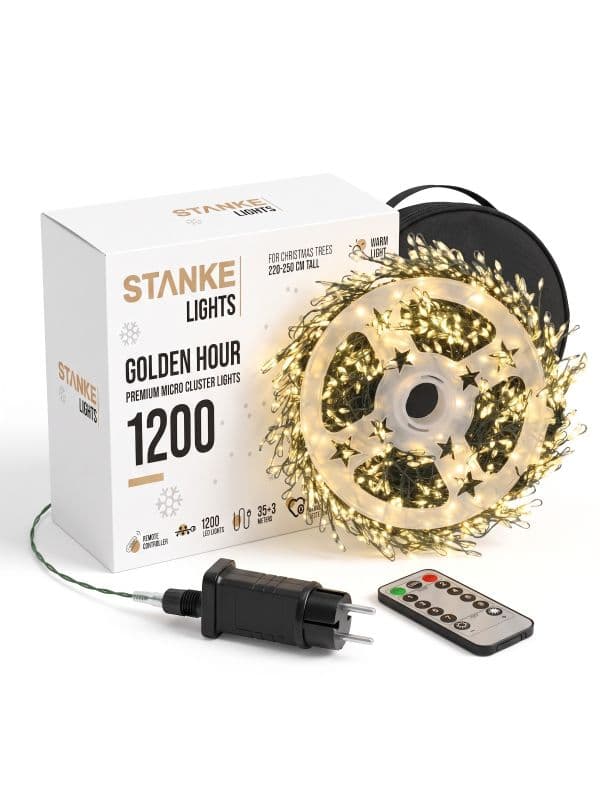
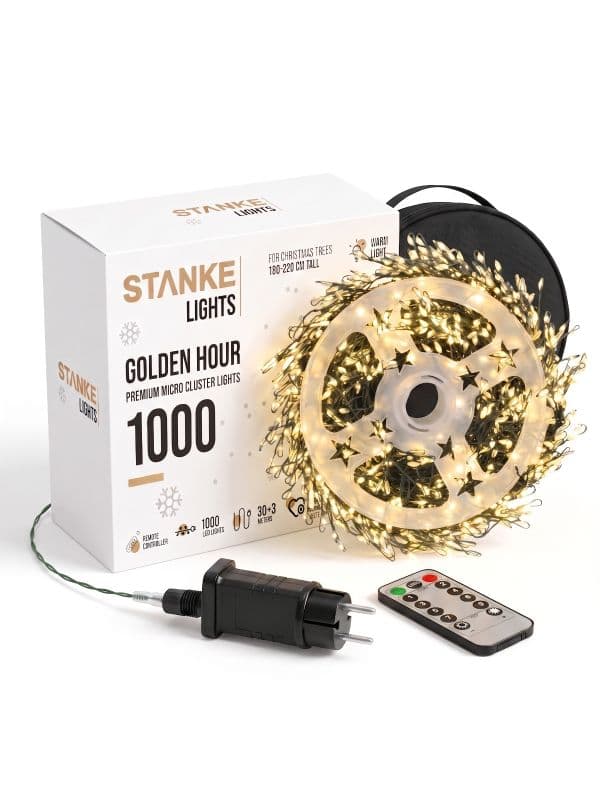
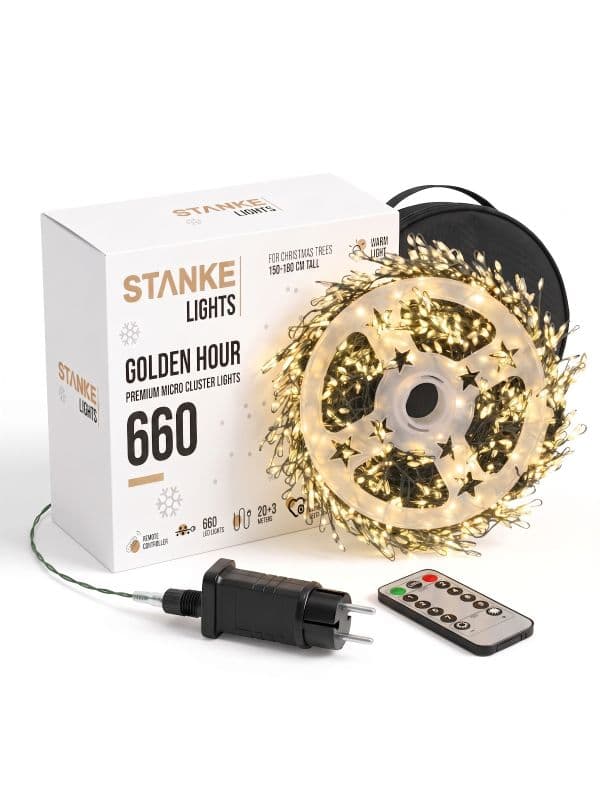
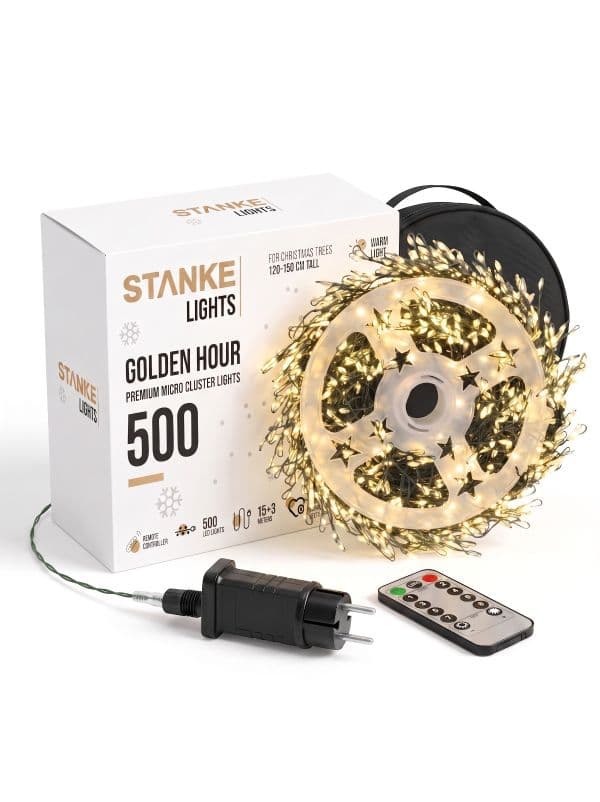
- Tree size and light length - At FairyTrees, we recommend the following LED counts for even illumination across dense PE/PVC foliage. A 120–150 cm tree needs approximately 15 m of lights with 500 LEDs. A 150–180 cm tree requires about 20 m with 660 LEDs. Trees between 180–220 cm need roughly 30 m with 1,000 LEDs, and a 220–250 cm tree calls for 35 m with 1,200 LEDs. These numbers assume full branch coverage; slim or sparse trees may need fewer.
- Branch type compatibility - PE branches are molded into 3D needle shapes, making them thicker and more rigid. They hold heavier string lights without bending or losing shape. PVC branches are flatter, flexible strips; too many lights or heavy strings can pull them out of position. On mixed-material trees, wrap heavier strings along the PE sections and lighter sets around PVC areas.
- Indoor vs. outdoor use - Indoor-rated lights work for any artificial tree placed inside. If your tree stands on a covered patio or near an open window, outdoor-rated lights should be weatherproof for safety and longevity. IP65 rated outdoor LED string lights are waterproof; for more exposed locations, IP67 protection covers temporary immersion. The IP rating of any set is only as strong as its weakest component, so check connectors and transformer housings as well.
- Power source and controls - Plug-in lights deliver consistent power for large displays with 500+ LEDs. Battery options give placement flexibility when no outlet is nearby but add the cost of replacement batteries. LED projection lights can create patterns for easy setup on smaller trees where minimal wiring is ideal.
Frequently Asked Questions
How many lights do I need for my artificial christmas tree?
Use about 100 lights per foot of tree height for average coverage. A 6-foot (180 cm) tree starts at around 600 LEDs for a standard look. Dense artificial trees with full PE branch coverage require more; our recommendation for a 180–220 cm FairyTrees tree is 1,000 LEDs on a 30 m string, which fills the interior and eliminates dark gaps. Warm white LED mini string lights create an elegant and cozy atmosphere at these densities without overwhelming the branch detail.
Can I use outdoor christmas lights on my indoor artificial tree?
Outdoor-rated lights are safe to use indoors, but they tend to have thicker wiring and bulkier connectors than indoor-only sets. For an indoor tree in your living room, indoor-rated lights are the easy way to get a clean look with thinner, more flexible wiring. If you plan to move the tree between indoor and covered outdoor space across different seasons, an IP65 rated set handles both environments.
How do I prevent christmas lights from damaging artificial tree branches?
Wrap lights loosely around each branch, avoiding tight knots or sharp bends at connectors. Choose lights with appropriately sized bulbs for the branch thickness of your tree; smaller LEDs work better on fine PE needles, while C7 or C9 bulbs suit larger, sturdier branches. Remove lights during storage by unwinding rather than pulling to preserve branch shape for the next season.
Should I install lights before or after shaping my artificial tree?
Install lights after assembling the tree but before final branch shaping. This gives you access to inner branches where light placement matters most for depth. Once the string is in place, shape branches outward over the wiring so it stays hidden while light reaches throughout the canopy. Test lights while the string is still flat on the floor to confirm all bulbs work before you begin wrapping.
Shop Christmas Lights in Warm White for Your FairyTrees Collection
Browse our selection of christmas lights chosen for compatibility with FairyTrees artificial trees. Each set is matched to our trees' PE and PVC branch construction, so you can select the right string length, LED count, and color temperature for your specific tree and enjoy a display that looks as natural as it does festive.